


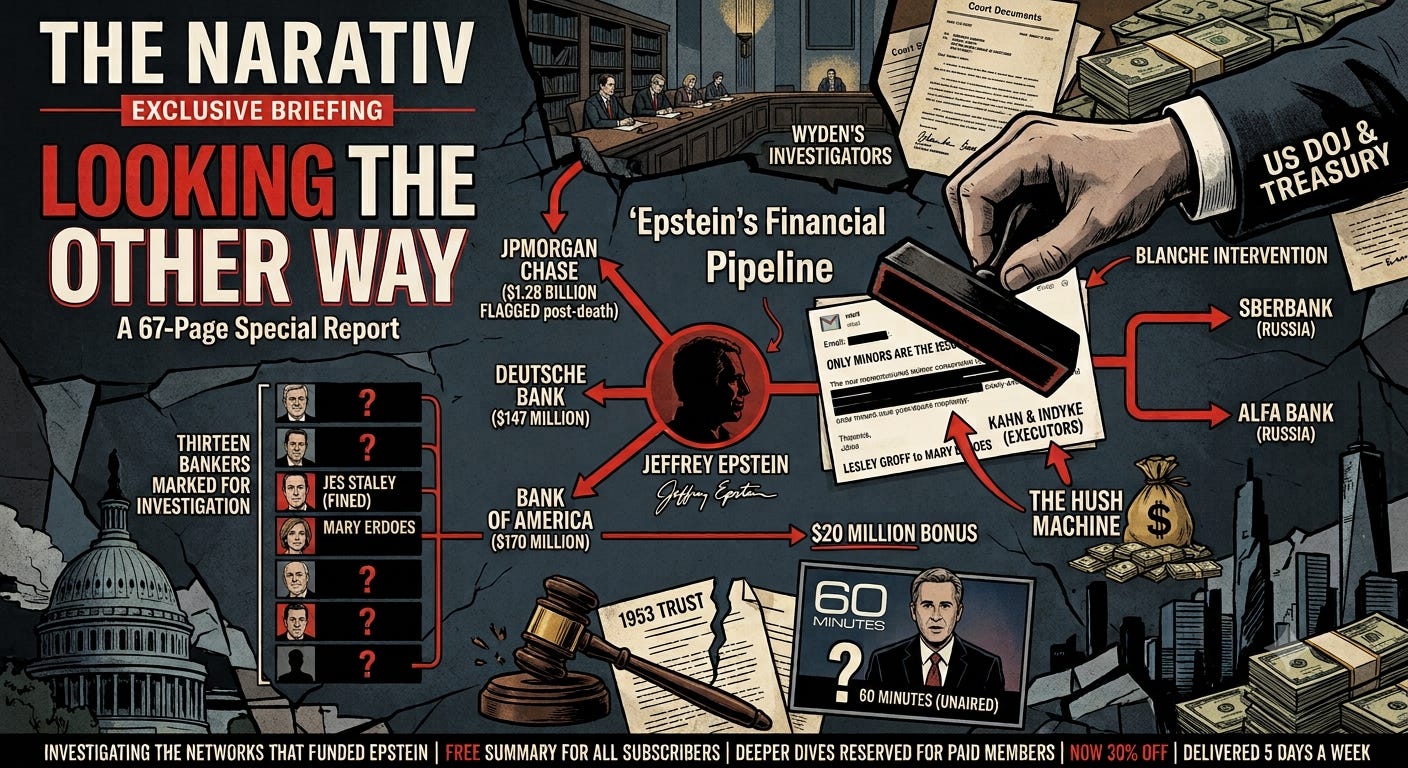
On Valentine's Day 2024, Ron Wyden's investigators sat in a Treasury Department reading room with the one set of documents that explains how Jeffrey Epstein paid for everything. Treasury wouldn't let them leave with copies. So they read, they memorized, and they spent the next two years rebuilding what they'd seen from court records and the DOJ's own Epstein files. On Tuesday, Wyden published the result — a 67-page report called "Looking the Other Way" — and named thirteen bankers whose conduct, he says, deserves criminal investigation.
Nothing will happen to them. Not because the evidence is thin — because the president's attorney general will do everything in his power to ensure nobody is prosecuted. Todd Blanche, the lawyer who defended Trump in the Stormy Daniels trial, has run the Justice Department since Trump fired Pam Bondi in April. Senate Republicans advanced his nomination for the permanent job the same day Wyden's report landed. Wyden wrote a prosecution memo addressed to the one prosecutor guaranteed never to use it.
The Banks Kept Washington Blind
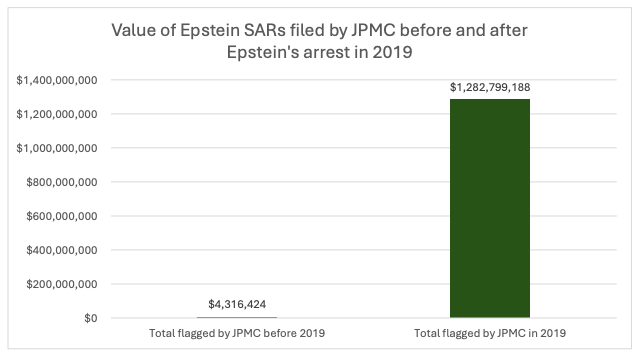
What the banks actually did was much more than "compliance failure." They actively hid suspicious money transfers in and out of Epstein's accounts from the Treasury Department officials who oversee suspicious activity. Suspicious activity reports are how the government sees crime move through the banking system — and three banks systematically hid Epstein's crimes from the US government. Between 2002 and 2016, JPMorgan filed seven of them on Epstein, flagging $4.3 million. That may seem like a lot, but it's a drop in the bucket compared to the 5,000 wire transfers worth $1.28 billion flagged after Epstein's death.
Deutsche Bank did the same in 2019: 1,140 transfers, $147 million, six years of banking Epstein without one timely report. Bank of America waited until 2020 to flag $170 million that Leon Black had wired to Epstein. For seventeen years, the banks kept the government blind while a sex trafficker moved more than a billion dollars past their tellers. When banks facilitate billions of dollars in crimes and hide it from the government, you get a runaway criminal enterprise that knows no limits.
The bankers knew. That is not my inference — it’s their own email. In 2012, John Duffy, chief executive of JPMorgan’s private bank, asked Epstein about his enormous cash withdrawals and accepted the answer “fuel payments in foreign countries” — some of them, Duffy noted himself, on the sanctions list. His response, in writing: “I did ask him to withdraw this cash from his aviation account for these payments.” The head of the private bank, coaching a registered sex offender on which account should absorb the cash. A year later, compliance director Maryanne Ryan put the whole relationship in one sentence: Epstein “has been known to pay cash for his massages, but only minors are the issue, and we have no proof.” Only minors are the issue. She wrote that down, at work, and nobody filed a report.
JPMorgan's story is that it exited Epstein in 2013 and that its executives, one bad apple aside, "acted with integrity." Narativ's own Greatest Heist Book 2 covers the moment Epstein was arrested and a JPMorgan banker discovered the news. But don't mistake this for personal loyalty to an individual. In emails we found in the DOJ's released files, Epstein's assistant Lesley Groff routes a client referral to Mary Erdoes — JPMorgan's head of asset and wealth management, six years after the supposed exit, five months before the arrest — and Erdoes replies: "connectivity is in motion."
PAID SUBSCRIBERS CAN ACCESS A DEEPER DIVE BELOW THE PAYWALL
