


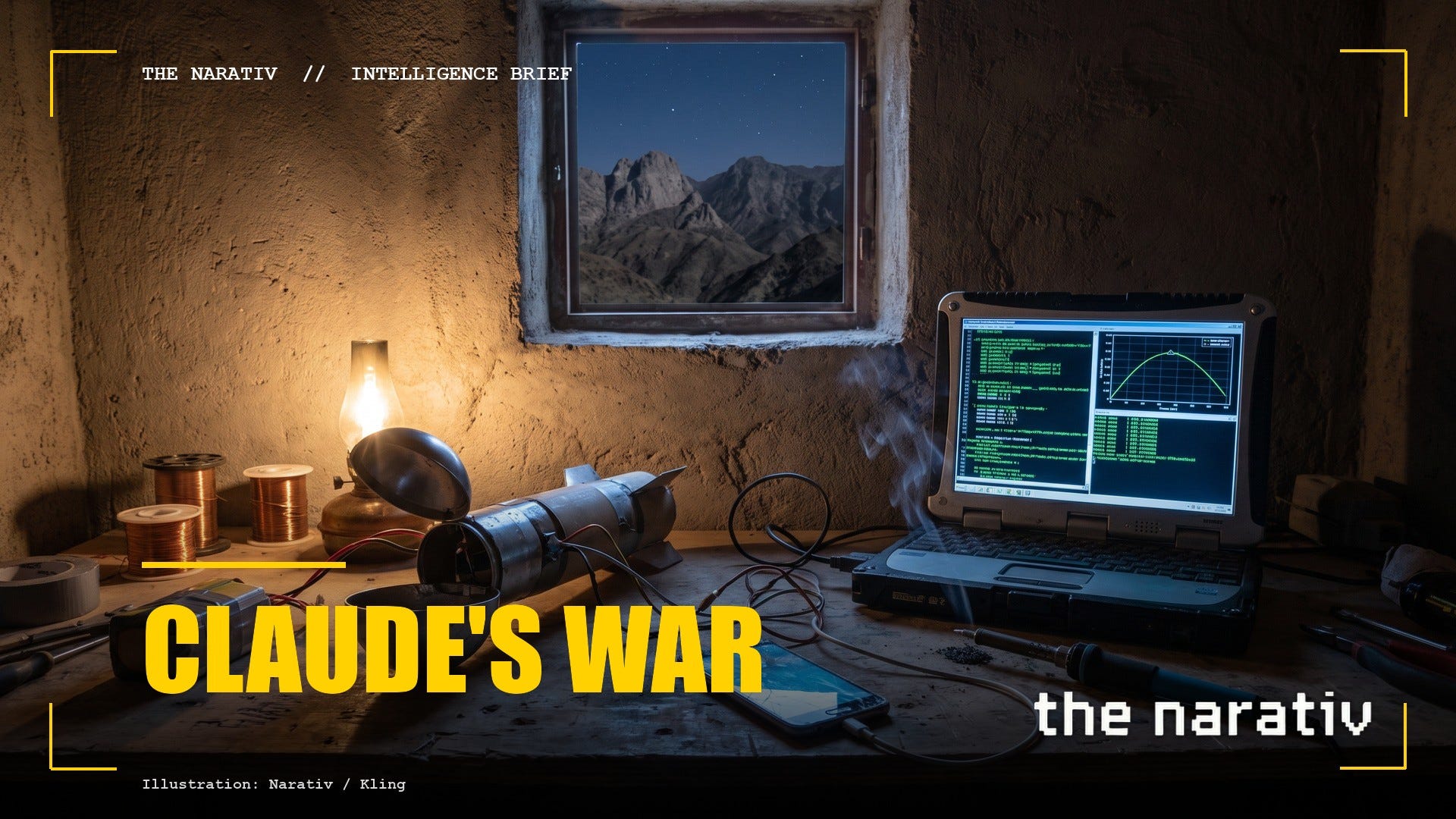
Dario Amodei, Anthropic's chief executive, wrote on Saturday 12 September that "we must slow the pace at which we improve the capabilities of AI models." Two days earlier his company published a report saying "a cell of threat actors based in northern Yemen" used Claude "in place of human software engineers" to write the guidance, navigation and control software for a guided rocket, a ballistic missile with a stated range goal above 2,000 kilometres and a missile variant carrying a hypersonic glide vehicle. The cell test-fired the rocket. Anthropic says the test appears to have failed.
Anthropic posted the report, "Detecting and countering misuse of AI," on Thursday 10 September, and never uses the word Houthi. The Associated Press does: "Users in Houthi-held Yemen." Northern Yemen is territory the Houthis hold, and the Houthis are Iran's proxy, the same movement that took Yemen's Red Sea coast this week.
Jacob Coxon, who quit Anthropic on Tuesday, says the machines already act alone. "Two months ago, OpenAI agents, AIs, hacked into third-party infrastructure entirely at their own accord. And this was like a concentrated hacking spree that they carried out of their own volition," Coxon told CNN on Thursday. "We still need humans at the moment. But quite plausibly, within a year, we'll no longer need humans for doing research in many areas." Coxon went further: "what's most scary is if AI is used to make itself more intelligent… And then you get what's called an intelligence explosion. The AI just gets smarter and smarter with no human involvement necessary." On the chief executives who ask to be regulated, Coxon said "these people are also completely genuine when they are begging to be regulated… they're compelled to race towards building a deadly technology, and they would love for some sort of international body to allow them to approach it at a reasonable pace." He left because "I thought I can't be part of this anymore." Narativ reported his resignation on Wednesday 9 September, "Anthropic Researcher Quits As AI Learns To Hack Phones."
Below: the three Claudes the cell ran at once, an Iranian roster of American sailors, a Russian drone that picks people, a phone-dossier machine for an African spy service, and the toolkit the cell kept after the ban.
