


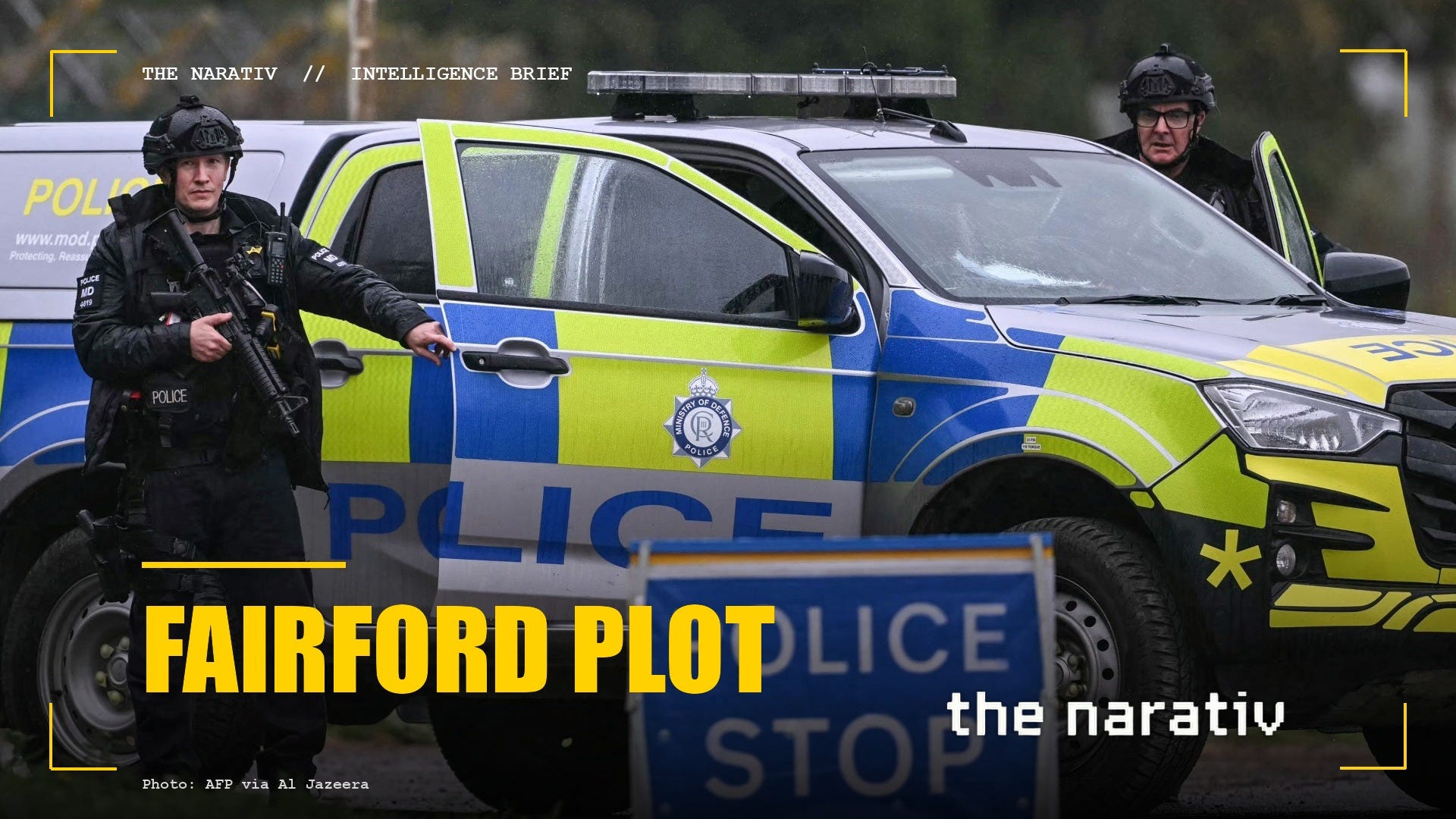
Britain's counter-terror police released the five men arrested beside RAF Fairford on bail Monday afternoon, and in the same breath said they may have been working for a foreign government.
Trump had already made up his mind. In Chicago on Sunday he said the men were "looking to do big damage" and that "we had them under view for a long time, and we got them." Whitehall told the BBC the opposite: the operation was not intelligence-led. A farmer in Whelford started it when she found three vans blocking her drive and "a large group of hooded and masked men" who ran when they saw her. She dialled 999 at 1:36am Sunday. Either Trump knew something London did not, or he said something that was not so. The local MP put it plainly: "two incompatible accounts of who knew what and when."
Then the police let them go. Laurence Taylor, head of Britain's counter-terror police, said Monday afternoon the men are going home "following extensive interviews and inquiries," under "stringent conditions on their movement and contact with others. They absolutely remain under investigation as we explore multiple lines of inquiry." Police are examining whether the incident "may be committed by proxies or individuals either knowingly or unknowingly working on behalf of a foreign state."
Nobody has been charged. Police arrested the five on suspicion of explosives offences and of preparing an act of terrorism. Police can hold terror suspects for 14 days without charge. They used less than two.
Three facts make the question in our headline worth asking. One of them is painted on the side of a van.
