


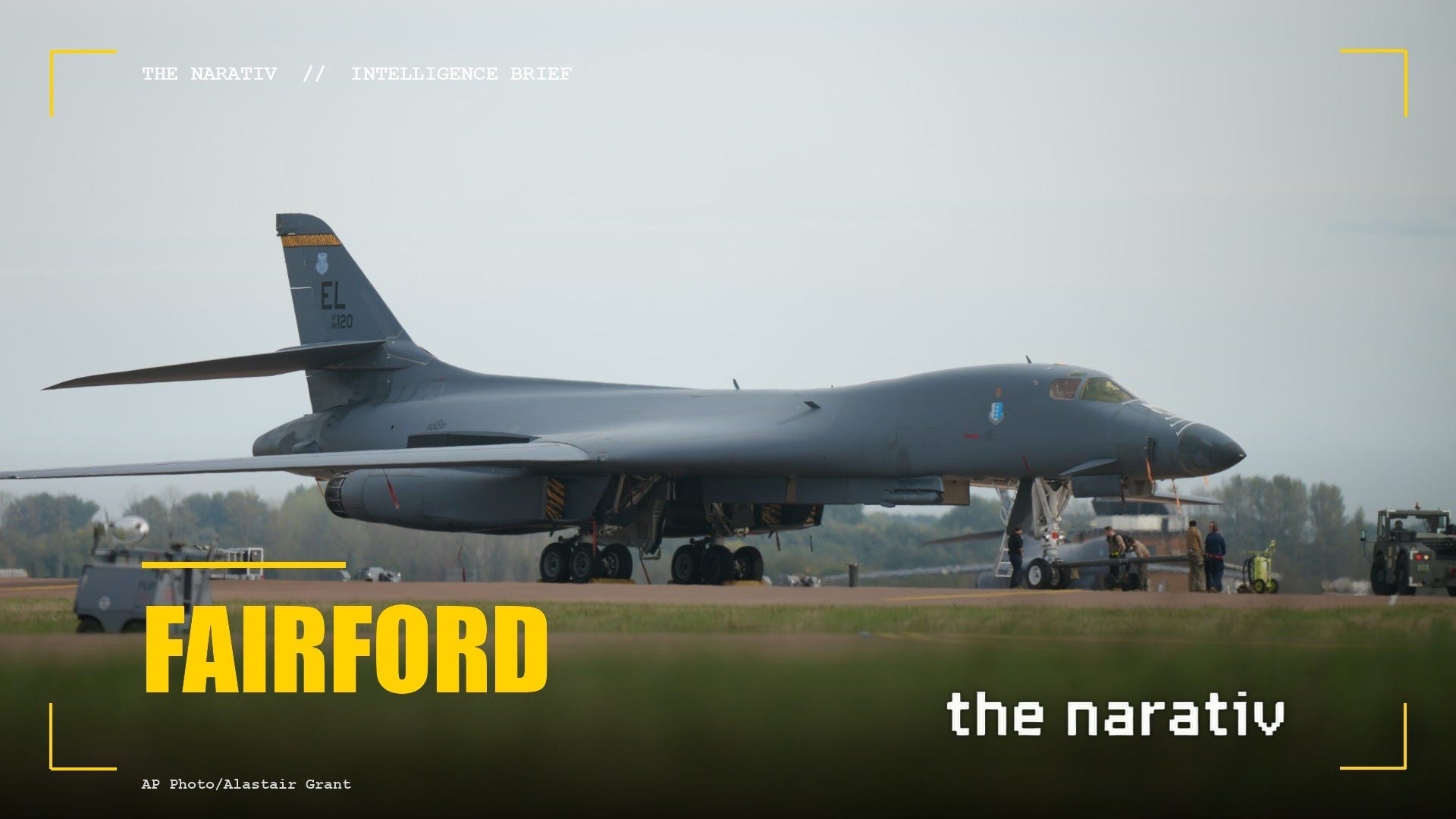
Donald Trump says he knows who threatened RAF Fairford. The police investigating it say they do not.
On Monday the president said, "We actually know the people that made the threat. They would be linked to Iran." The day before, the Pentagon had flown its last bombers out of the Gloucestershire base, 12 B-1Bs that it says have "redeployed to their home stations in the United States." Trump describes the same move as "around a little bit, not very far."
On Tuesday Britain's counterterrorism police announced their seventh arrest, a 22-year-old Briton picked up in Westminster, and Vicki Evans, who coordinates the investigation, said her teams are working "around the clock, and at pace, to identify the motivation behind events in Gloucestershire." Nine days in, nobody has been charged and no country has been named, which means the police still cannot say in public why anyone drove to Fairford.
Trump has done this before. The first time was Sept. 27, when a farmer's 999 call sent police to three vans in Whelford, the village at the edge of the base, and officers arrested five people in their 20s, found petrol and found no explosives. Later that day Trump told a crowd in Chicago that American and British agencies "had them under view for a long time, and we got them." Whitehall told the BBC the operation was "not intelligence-led," and the next day police bailed all five. Trump said, "I wouldn't have done that."
So who sent the vans?
Five days ago the police were talking about a foreign state. On Oct. 1, announcing the sixth arrest, Evans said her teams were "looking at all possible angles – including possible foreign state involvement." Tuesday's statement, announcing the seventh, does not mention a foreign state; it says the motive is still being identified.
Prime Minister Andy Burnham says there are "strong indications" that Iran "played a part," Downing Street says the base is safe, and Iran's embassy in London calls the speculation "unfounded and malicious." The sixth arrest, a 25-year-old with British and Iranian citizenship, ended in bail like the first five. The 22-year-old is the only one of the seven still in custody.
On Sept. 28, asked whether Iran was behind Fairford, Trump said, "might be." "I know the answer. I can be very specific, but I'd rather not say it," he said. On Monday he said it.
Twice now the president has claimed to know something about Fairford that the people investigating it have not produced: first a long surveillance operation that Whitehall says the arrests did not come from, now the identity of the people behind the threat. Either Washington has told Britain's police something they cannot yet prove, or the president is ahead of the evidence again. The difference matters because the bombers are gone. The Pentagon pulled them the day before Trump named his culprit, on a threat he describes and the police do not.
The 22-year-old's custody clock is running: either he becomes the first charge in the case, or he becomes the seventh bail, and seven arrests with no charges will be hard for Evans to defend at the next announcement. Burnham, who has already pointed at Iran, will face the question Trump has put on the table: has London asked Washington for what the president says he knows, and if it has, why are the police still working out the motive? And Fairford itself stays open, defended, and without its bombers.