

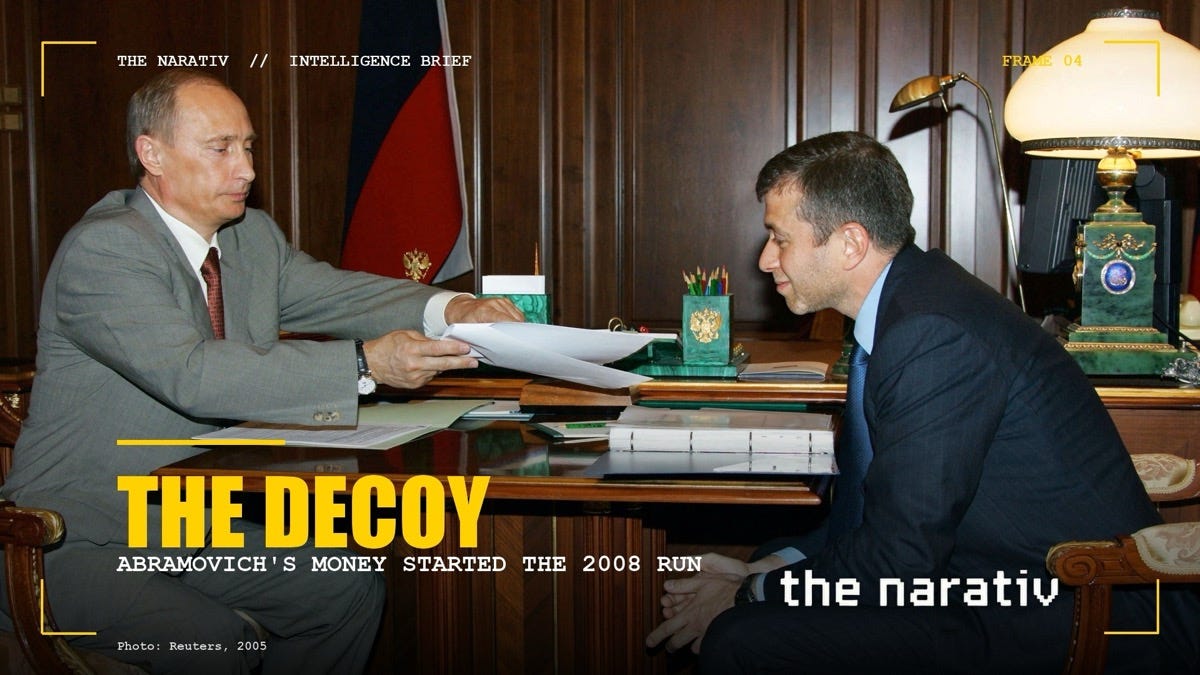
Roman Abramovich's money made the first run on the Bear Stearns mortgage funds where the 2008 financial crash began, and Jeffrey Epstein's offshore company sped the next collapse and got paid out of it, two chapters of The Greatest Heist show.
On April 18, 2007, an analyst from Concord Management of Tarrytown, N.Y., met Bear Stearns fund manager Ralph Cioffi and told him a client was thinking of pulling $57 million from Cioffi's High-Grade Enhanced Leverage fund. The client pulled all of it the next day. A week later Cioffi hid that exit from about 200 investors on a conference call, and federal prosecutors in Brooklyn later charged him for it. Prosecutors called the client "Major Investor #1" in the indictment and kept the name out. Cioffi's own lawyers named Concord in a court filing on Nov. 3, 2009.
Concord worked for one man. The Securities and Exchange Commission sued Concord in 2023 for secretly managing more than $7 billion in U.S. markets for "a former Russian political official." Concord's lawyers, asking for documents in that case, named him: Roman Abramovich. The New York Times reported in 2022 that Concord had placed his money in more than 100 funds, Bear Stearns funds among them.
Abramovich made the money in Russian oil. He won control of the oil company Sibneft in a 1995 state auction for about $100 million and sold it to Gazprom, Russia's state gas company, for $13.1 billion in 2005. He put the proceeds into offshore companies that bought into hedge funds. When Concord's analyst walked into Bear, Abramovich was the governor of Chukotka, a Russian region on the Bering Strait. He had offered to resign in December 2006, and the Kremlin said on Feb. 9, 2007, that he would stay. Britain sanctioned him in 2022, saying he had "a close relationship for decades" with Vladimir Putin.
So a sitting Russian governor placed the first withdrawal of the crash. Cioffi lost his investors about $1.4 billion, and his two funds filed for bankruptcy on July 31, 2007.
Epstein took the credit for it. On June 30, 2008, the morning he reported to jail in Palm Beach, Page Six reported, citing his publicist, that Epstein was Major Investor Number One. Bear Stearns' lawyers later said in arbitration that he never had anywhere near $57 million in the funds. He had $20.2 million in the fund that died, his own settlement papers show. His own sworn filings say he called a Bear co-president in March, April and May 2007 to get out, the co-president talked him into staying, and JPMorgan settled his claim for $9.2 million in 2011. For 18 years his name covered a Russian exit.
Zev Shalev puts Epstein on the other end of the same crash in Chapter 10. Epstein chaired Liquid Funding Ltd., a Bermuda lender Bear Stearns managed that held billions in mortgage debt. He resigned as chairman on March 19, 2007, a month before Concord's meeting, and kept his ownership units until JPMorgan bought them out in 2011. In July 2007, Bear and Liquid Funding made eight margin calls on American Home Mortgage, one of the country's largest home lenders, for $35.3 million. They called $13.6 million on July 30, and the lender defaulted that day. The lender paid Liquid Funding in full on Aug. 1 by selling the collateral to a Bear Stearns unit. American Home Mortgage filed for bankruptcy on Aug. 6. Three days later the French bank BNP Paribas froze three funds over U.S. subprime losses, the day most economists mark as the start of the global crisis.
Abramovich got out first, in April. Epstein's company collected in August, as the lenders fell. Concord got all its money out. Liquid Funding got paid in full. The 200 investors on Cioffi's call did not.
We found no document that shows who told Concord to run on April 18, and none that puts Epstein and Concord in contact, but there are copious Epstein ties to Russian officials and Putin himself. Shalev makes the charge on the timing: Kremlin-connected money lit the run, and Epstein's company accelerated the collapse and profited from it. Concord's founder, Michael Matlin, did it again in 2022. In early February, days after approving 10 new investments, he ordered all of Abramovich's U.S. holdings sold, the SEC says, weeks before Russia invaded Ukraine and Britain froze his assets.
Prosecutors in Jersey, where more than £5 billion of Abramovich's money stays frozen, are investigating whether the Sibneft fortune is the proceeds of crime. If they prove it, the first money out of the 2008 crash was criminal money.
Democrats take control of Congress in January. On Oct. 15, Sen. Elizabeth Warren, D-Mass., and Rep. Robert Garcia, D-Calif., in line to chair the House Oversight Committee, filed a bill to force the Fed, the FDIC, the Comptroller of the Currency and the SEC to open their files on Epstein's money. Warren and Garcia now have to answer the question: if criminal money moved with intent at the start of the crash, who gets charged, and who pays back the millions of Americans who lost their homes, jobs and savings in it?
READ THE LATEST CHAPTER

OR THE ENTIRE BOOK 1 & BOOK 2