

Jacob Kaarsbo spent a career inside Danish military intelligence. From 2005 to 2007, on loan to Denmark’s foreign ministry, he sat at the United Nations Security Council during Denmark’s rotating turn — working Kosovo, Bosnia and Georgia, and meeting Russia’s ambassador Vitaly Churkin more than once a week, in the open sessions and the closed chambers behind them. “He didn’t look like your typical Russian diplomat,” he said. “He looked quite fit… He spoke English really well.” Churkin, he said, was “a pro.”
Then Zev asked the question the whole story turns on: diplomat, or intelligence officer? Kaarsbo did not hedge. “Exactly,” he said. Churkin carried the diplomatic dossier and, in Kaarsbo’s assessment, “another dossier where he was likely an intelligence professional — also an operative.” A spy in an ambassador’s chair, and a good one.
Kaarsbo learned the rest the way most people did — later. Churkin dropped dead in New York in February 2017, a month after Donald Trump’s inauguration. No U.S. autopsy followed; the Russians handled it. “His cause of death could be anything, because we only know this from the Russians,” Kaarsbo said. Then he offered the line that framed the hour: “Coincidence takes a lot of planning.”
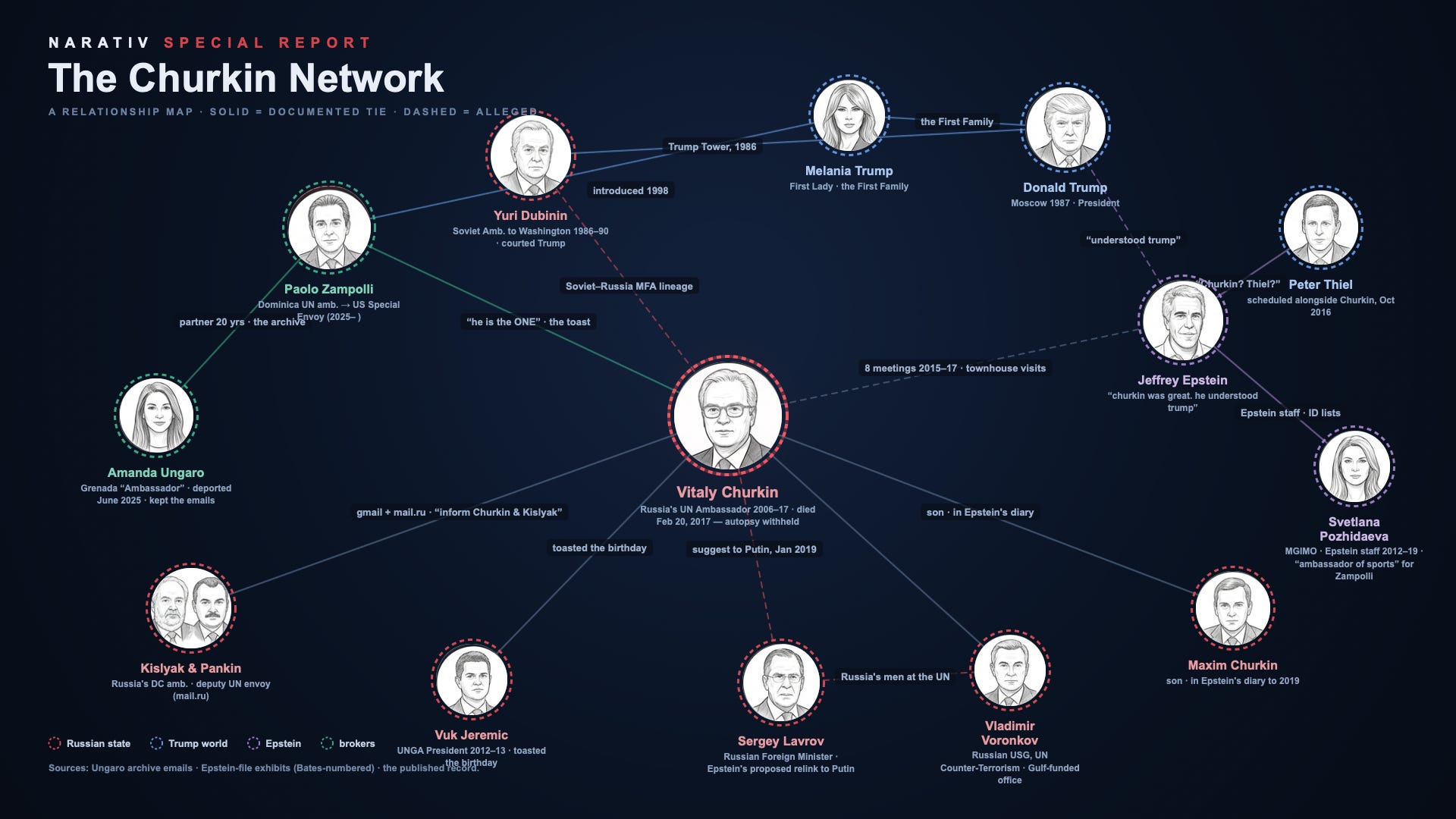
He went further than Zev expected. Shown the shape of the network — Churkin to Epstein, Epstein to Trump, the same names surfacing again and again — Kaarsbo named it plainly. “This is indeed a Russian operation,” he said. He described the method he knows from the inside: Moscow gathers a little compromise, leans on it for more, and wraps a “treasonous web” around a target who may not, at first, know he is caught. When Zev raised the counter-narrative — Vice President JD Vance’s claim that the Epstein affair is “all Mossad and CIA” — Kaarsbo waved it off. Every time he digs, he said, the same thing surfaces. “It was not a hoax. It’s Russia. It’s all over.”
To reach the root, Zev went back to 1983. He played a clip of the former KGB officer Yuri Shvets describing how the KGB moved to cultivate Trump — through the Soviet ambassador Yuri Dubinin and his daughter, whom Shvets believed to be an intelligence officer — and found in Trump “the ideal target”: vanity, narcissism, greed. Churkin, in those same years, helped organize Trump’s 1987 trip to Moscow. Kaarsbo said he had watched the same Shvets interviews before he published his own book in March, which traced the economic links; the Epstein files, released afterward, “put everything into perspective. It does add up.” Watch the interview with Yuri Shvets below (Paid subscribers)
Paolo Zampolli — the Italian who represented a Caribbean island at the UN, moved in the trade of black-market diplomatic passports Kaarsbo described, and stood closest of all to Churkin — is the man who brought Melania to America and now serves in Trump’s government. Kaarsbo placed the recent Budapest trip: Zampolli traveled there with the Vice President to rally the crowd behind Viktor Orbán. Zev put the stakes to a European: if a Danish first lady kept a decades-long friend who was a Russian operative, wouldn’t it be the only story in the country? “Of course,” Kaarsbo said. What baffles him is the silence — a party and its institutions that look at “obvious, obvious, deep links” and do nothing.
Zev closed on the scale. Fifty years, one operation, kept quiet and effective — America caught off guard. Kaarsbo reached for John Bolton’s image: the Kremlin “drinking vodka straight out of the bottle” over what it pulled off. “It is actually a remarkable intelligence operation,” he said, “and one of the most successful.” Then, once more, the line: coincidence takes a lot of planning.
Thank you Nick G, A Dude On The Couch, Lori Modafferi, Dominique, Patricia Wren, Deborah J., and many others for tuning into my live video with Jacob Kaarsbo! Join me for my next live video in the app.