

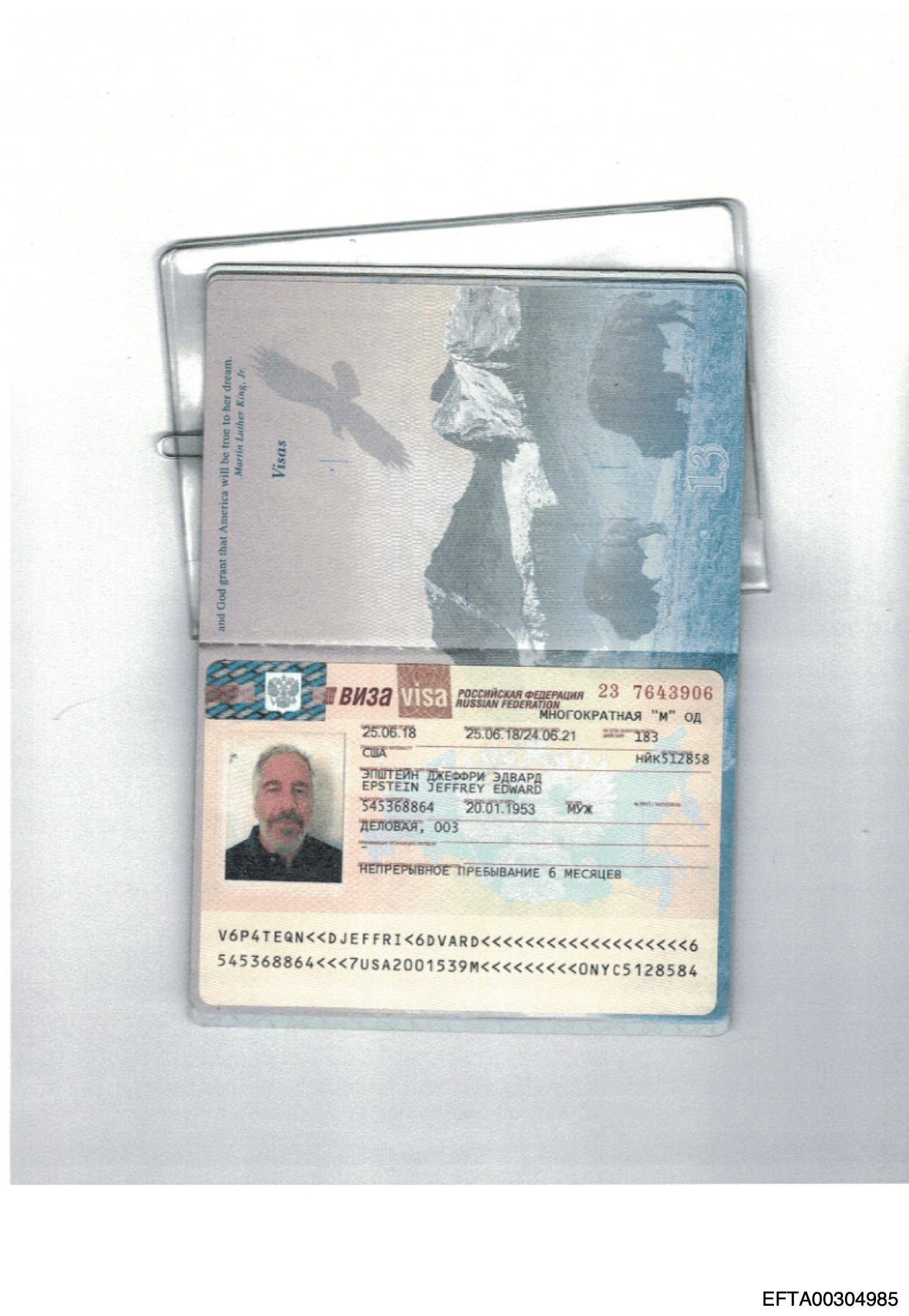
Passport documents and visa applications from the Epstein files reveal what no previous investigation has established: Jeffrey Epstein held Russian visas for at least sixteen years, dating back to 2002 — and at least one of those visas was sponsored by the veterans’ organization of the FSB’s elite special forces unit.
Until now, the earliest documented connection between Epstein and Russian intelligence was 2014, when the Dossier Center established his relationship with FSB Academy graduate Sergei Belyakov. The passports push that timeline back by twelve years — and point to a handler who lived four blocks from Epstein’s Manhattan townhouse: Vitaly Churkin, Russia’s Permanent Representative to the United Nations, and the man who helped organize Donald Trump’s first trip to Moscow in 1987.
THE VISA APPLICATION
A Russian visa application obtained from the Epstein files — document EFTA00304985 — reveals that in 2010, Jeffrey Epstein applied for a Russian business visa. The application shows:
Name: Jeffrey Edward Epstein
Passport: 469911707, issued by the U.S. Department of State
Visa type: Business, Multiple Entry
Date of issue: May 27, 2010
Valid until: May 26, 2020 — a ten-year visa
Entry window: January 18, 2011 to January 18, 2012
Itinerary: Moscow
But the most explosive detail is in Field 13 — the Russian institution or organization to be visited:
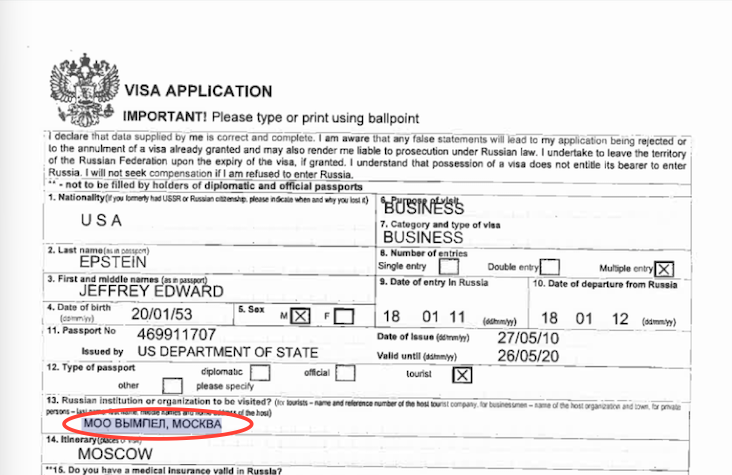
МОО ВЫМПЕЛ, МОСКВА
MOO Vympel. Moscow.
Вымпел — Vympel — is the name of the FSB’s elite special forces unit, Spetsgruppa V, created in 1981 by KGB Major General Yuri Drozdov for deep penetration, sabotage, and espionage activation in case of war. MOO Vympel is the veterans’ organization of this unit, headed by Eduard Benderskiy — a Vympel operative who built one of Russia’s largest private security firms and was recently sanctioned by the United States, United Kingdom, and Australia for connections to the Evil Corp hacker group.
Jeffrey Epstein’s Russian business visa wasn’t facilitated by a trade group, a bank, or a cultural organization. It was facilitated by the FSB’s own special forces veterans’ association.
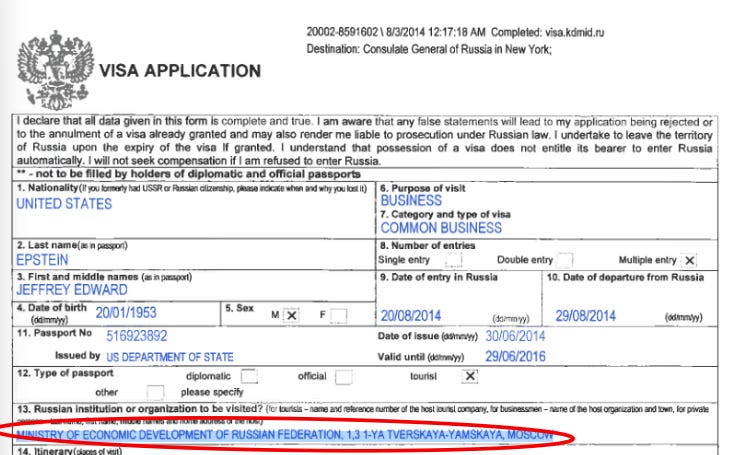
But that was not the only channel. A second visa application in the Epstein files lists a different sponsoring organization:
Ministry of Economic Development of the Russian Federation, 1-ya Tverskaya-Yamskaya, Moscow.
That is the ministry where Sergei Belyakov — FSB Academy graduate, Epstein’s documented Kremlin contact — served as Deputy Minister. Two visa applications. Two sponsoring organizations. One from the FSB’s special forces apparatus. One from the Russian government ministry that housed his handler. Two tracks running in parallel to the same asset.
THE PASSPORT TRAIL
Based on passport photos and paperwork in the Epstein files — documents EFTA00311304, EFTA00311310, EFTA00292666, and EFTA00304985 — Jeffrey Epstein appears to have been issued Russian visas in at minimum:
2002, 2003, 2004, 2006, 2007, 2011, 2014, 2015, and 2018 (the last valid until 2021).
Nine visas across sixteen years.
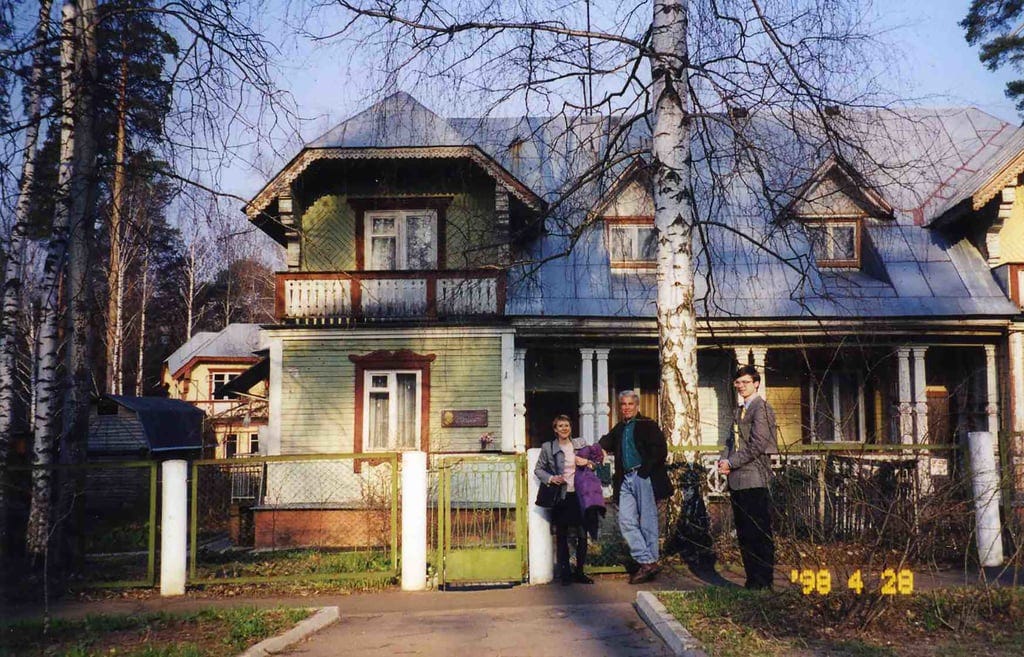
But the documented trail goes back even further. A photograph posted to Flickr by tech investor Esther Dyson — taken in April 1998 — shows Epstein posing with Dyson and Pavel Oleynikov outside Andrei Sakharov’s house in Sarov, in the Nizhny Novgorod region. Sarov is a closed city — a restricted-access ZATO — home to Russia’s Federal Nuclear Center, RFNC-VNIIEF, where Sakharov developed the Soviet hydrogen bomb. Entry requires authorization from the Russian government. Epstein was inside a closed nuclear city four years before his first documented visa.
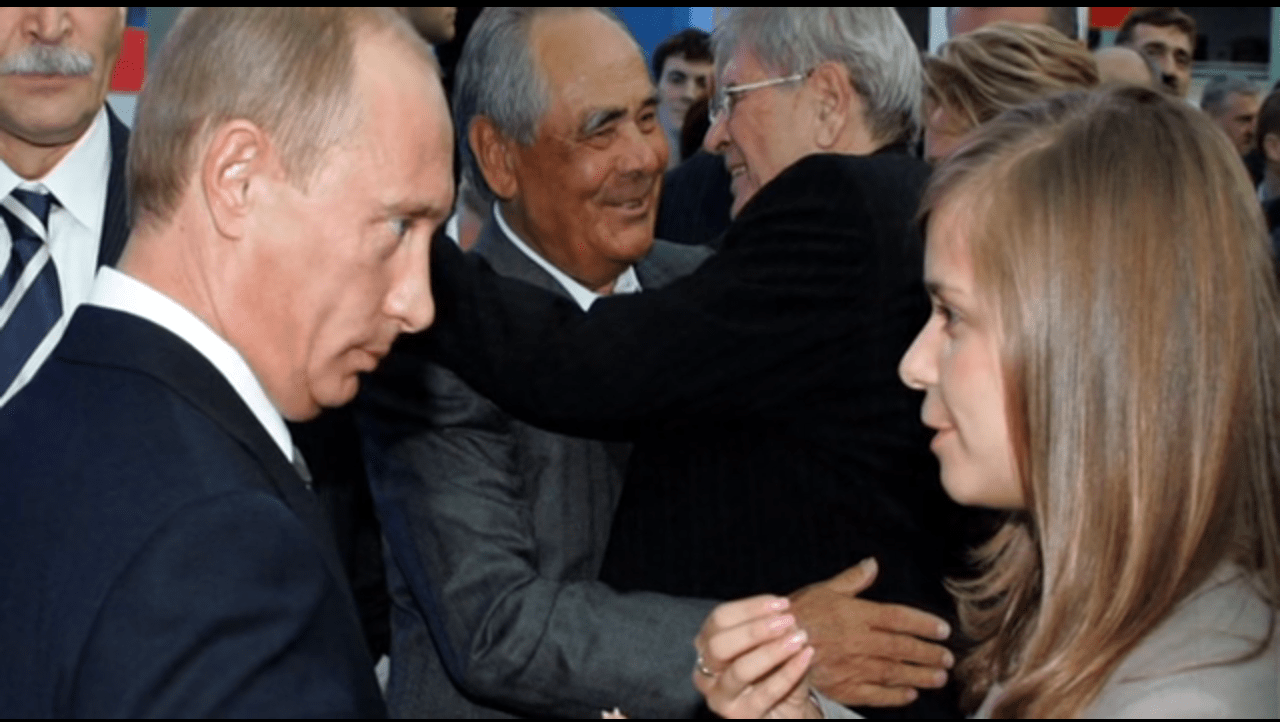
Dyson would later help Masha Drokova — former Nashi (pro-Putin youth movement) activist and associate of the Kremlin’s “chief troll” Konstantin Rykov — obtain an “Einstein visa” to enter the United States. Drokova became Epstein’s press secretary. Dyson sits on the board of Yandex, Russia’s largest search engine. Epstein’s Russia network was not episodic. It was institutional.
This contradicts the prevailing account. The Dossier Center investigation, funded by Mikhail Khodorkovsky, documented Epstein’s relationship with FSB Academy graduate Sergei Belyakov beginning in 2014. French historian Françoise Thom, writing for European Security in July 2025, stated there was no record of Epstein traveling to Russia before 2014.
But the passports and photos tell a different story. Epstein was photographed inside a closed Russian nuclear city in 1998. He held Russian visas from at least 2002. The unredacted flight logs confirm it: his Boeing 727 (tail number N908JE) flew from Moscow Vnukovo Airport to St. Petersburg Pulkovo Airport in November 2002 — a transfer within Russia, meaning he had already arrived in Moscow by other means.
The question that reframes everything: if Belyakov was the handler from 2014, who was the handler from 1998 to 2013?
The answer may be four blocks away.
BEYOND THE PAYWALL: THE HANDLER, MYSTERIOUS DEATH, THE GIRLS AND THE FLIGHTPATHS
