

Exclusive: The Billionaire, the Predator, and the Braque
Inside the art-laundering scheme connecting Jeffrey Epstein, Leon Black, and America’s elite.

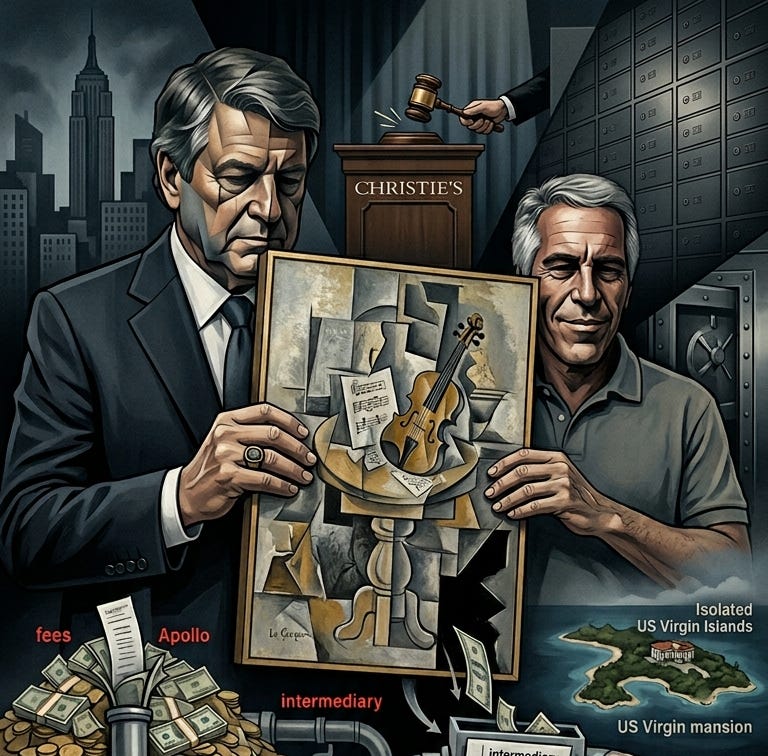
As Braque’s round-table paintings go, Le Guéridon of 1911 is one of the lesser ones. Small — sixteen inches by thirteen, the size a man can carry under one arm. A Cubist still life: a pedestal table, the curved body of a violin, a sheet of music broken into facets, the whole thing the color of dust. Not the looming vertical guéridon at the Center Pompidou, nor MoMA’s 1928 Le Guéridon, those get all the attention. The 1911 round table appeared only once for a single unremarkable season at MoMA in 1989 — on loan, for the Picasso and Braque: Pioneering Cubism show — and afterward went to a Tokyo gallery before disappearing into the private market.
At $9 million, it’s not the most valuable Braque, but its story unravels a billion-dollar tale of criminal intrigue, revealing the lengths Jeffrey Epstein went to for his billionaire clients.
The client was Leon Black, son of United Brands’ scandal-plagued chairman Eli Black. Leon joined Michael Milken’s Drexel Burnham Lambert after Dartmouth, ran its mergers-and-acquisitions desk, and left after Drexel’s 1990 collapse to co-found Apollo Global Management. He’s well networked from Moscow to the Capitol, and he was Epstein’s longest lasting client.
How Black met Epstein is a matter of historical debate. The New York Times says they met in 1996, but some on Wall Street will whisper to you in a quiet moment that Black knew Epstein through junk bond king Michael Milken in the late 1980s, a fact we couldn’t completely verify.
Black also owns one of America’s largest private art collections and, according to Apollo’s internal probe, paid Jeffrey Epstein $158 million between 2012 and 2017 for “tax and estate advice,” including “like-kind exchanges.”
Here’s how a like-kind exchange works. Sell an appreciated asset, and you pay capital-gains tax. Swap it for a like-kind asset, and the tax is deferred. If you keep swapping, the tax stays deferred. Real-estate developers built fortunes on this process. Before Congress ended it in 2018, the rule applied to art, too. Black did not sell his Giacometti and 1911 Braque to buy Cézannes. He exchanged them. The same paintings and money changed hands—just under different terms. A sale is taxed. An exchange is not.
An exchange, however, comes with a catch. The IRS requires the asset to be sold to a bona fide buyer for cash. A qualified intermediary must hold the cash, and the transaction must be completed by a set deadline. In this case, the deadline was midnight, November 23, 2016. Heather Gray, art counsel at Black’s family office, clarified the urgency to Epstein six weeks earlier: “The exchanges must be completed by midnight on Wednesday, November 23, 2016.” By late November, as the deadline neared, Larry Gagosian—the most powerful art dealer—had yet to produce a buyer.
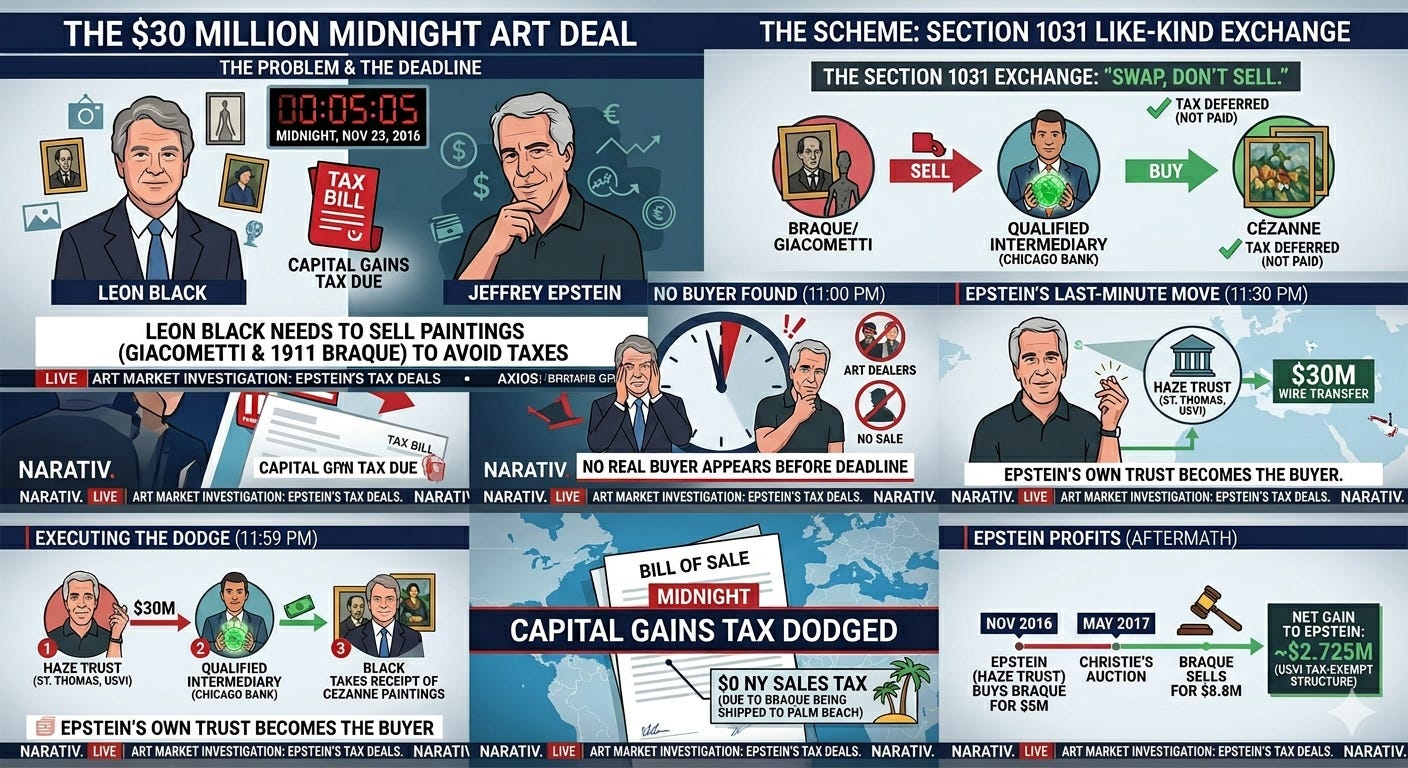
With the clock running, Epstein came up with the buyer himself, and the narrative takes a decisive turn. The buyer was a trust Epstein controlled—the Haze Trust, registered on a quiet street in St. Thomas, U.S. Virgin Islands. On the deadline day, the Haze Trust bought the Giacometti for $25 million and the Braque for $5 million. Darren Indyke, Epstein’s lawyer, wrote the wire instruction. Epstein approved it in five words:
“ok to wire the 30 million.”
No dealer. No introducer. No commissioned middleman. A $30 million art movement between two elite collectors, with every intermediary serving the tax plan, not the market.
Here is where the hustle does the work. The money the Haze Trust used to buy Black’s paintings was actually Black’s own—routed through the $158 million in fees he had paid to Southern Trust Company, Epstein’s U.S. Virgin Islands entity. Southern Trust owns Southern Financial LLC (“Member contributions $225,545,413”), which is the parent of the Haze Trust. Black paid Epstein the fee; Epstein’s company funded the LLC; the LLC funded the trust; the trust paid Black’s entities $30 million for two of Black’s paintings. In this arrangement, the seller’s tax adviser was also the buyer, and the buyer’s funds originated as the seller’s fees. The capital gains tax was effectively deferred.
On the deadline day, $30 million left the Haze Trust, ran through a Bank of America account held by the Chicago Deferred Exchange Company — the qualified intermediary — and landed in Black’s entities, AP Narrows LP and LDB 2011 LLC. Black took delivery of two Cézannes. The capital-gains tax did not come due. Midnight was beaten. And Epstein’s Haze Trust got the Giacometti and the Braque.
Heather Gray’s memo had flagged it in passing:
“The Braque is owned by Narrows Holdings LLC (and is collateral on the Bank of America loan).”
Normally, a lien release like that involves multiple banks clearing the amounts. Here, one institution sat on three sides of the $30 million transaction: the lender against the painting, the custodian of the §1031 intermediary’s funds, and the processor of the wire. Bank of America had to release its lien on the painting at the same moment the proceeds arrived — and move $30 million through three accounts to do it. Anyone who’s ever tried to cash a banker’s check knows you usually have to walk it over to the receiving bank. Not here.
In effect, the capital gains tax was deferred. Another tax also disappeared: by shipping the painting to Palm Beach, New York sales tax was avoided. The memo addressed it:
“$0 NY sales tax.”
After this swap, Epstein’s trust now held a Braque it had paid $5 million for. Rather than keep the painting, less than six months later—on May 15, 2017—Christie’s sold Le Guéridon in its Impressionist and Modern Evening Sale in New York, lot 5A. The hammer fell at $8.8 million. The Haze Trust was wired $7,725,000—a gain of $2,725,000 on a painting it had owned for fewer than two hundred days. No sales tax had been paid to acquire it.
The Braque was not the only painting moving through this structure. The Giacometti—the other half of the $30 million wire, the $25 million share—appears in the Haze Trust’s books in 2017 and then vanishes from public sales records after that. Its destination post-Epstein remains as the next open thread. Other works followed similar paths over time. The Haze Trust kept buying art from Jeffrey Epstein’s clients on deadlines and kept selling it. The tax got killed every time. Understanding this ongoing process is vital to the scope of Epstein’s operation.
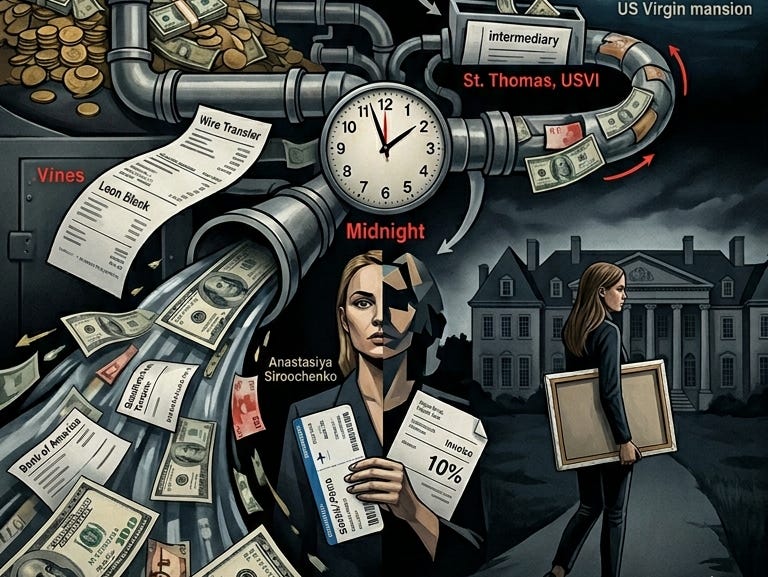
This is where Anastasiya Siroochenko comes in. She was not involved in the Braque’s initial swap into the Haze Trust but played a pivotal role in subsequent transactions. Siroochenko is the principal of a New York LLC called Sublime Art, incorporated in Manhattan on February 8, 2013.
Siroochenko was one of Jeffrey Epstein and Jean-Luc Brunel’s models at MC2 — the same one who was hired by Dasha Druikova and Svetlana Pozhidaeva from Russia using Epstein visas. Between 2011 and 2015 — years before Sublime Art existed — Leon Black wired Anastasiya Siroochenko at least $2.5 million directly. The accountants classified the transfers as “gifts.”
Within hours of the Christie’s auctioneer hammering the price of the Braque of $8.8 million, the Haze Trust’s net of $7,725,000, Richard Kahn — Epstein’s accountant, emailed Darren Indyke:
“Please advise on commission to sublime art … is the correct amount 10% or 772,500?”
The two figures were the same: ten percent of the Haze Trust’s net was $772,500 exactly. Sublime had brokered nothing on the Braque. Christie’s had run the sale; Christie’s had brought the buyer; Christie’s was the broker. She served as an advisor to the Haze Trust. A lot of people advise on art; few of them get 6-figure sums as commissions, but Siroochenko did.
Intriguingly, just as the Braque was being sold, Epstein’s secretary, Leslie Graff, was booking Siroochenko’s flights through Amex Centurion from Sochi to Paris and back. Sochi is the Russian Black Sea resort that has been a playground of the Russian security state since the KGB. It’s where Putin has his palatial dacha. The same week, the Braque was sold at Christie’s.
Four months after the Braque crossed Christie’s auction floor, in September 2017, Sublime Art was at the center of another Black-owned painting changing hands. This time, Sublime was the broker and pocketed $1.8 million for Paul Klee’s “Was fehlt ihm?” (1930), transferred from Black Narrows Holdings LLC, a Black entity, to Laura Gowen Art Connection SA, based in Switzerland, for $7.8 million.
On September 18, 2018, Narrows Holdings invoiced Sublime Art for the same Klee at $6 million. Sales tax was waived because Sublime presented a resale certificate. The wire ran through Bank of America. Whether the Geneva sale ever closed, and where Klee’s What’s Wrong with Him? hangs now; it’s not known, but the timeline suggests it was sold to a buyer in Geneva and then returned in a year, all through a New York LLC controlled by a young woman from Sochi whose office was at 244 Fifth Avenue.
What Anastasiya Siroochenko was actually doing in this circuit — and for whom — is a question for another piece.
The trust that pocketed the Braque’s $2.7 million was nested in the most sheltered corner of the Epstein universe, the Southern Trust Company — the Epstein entity that held a U.S. Virgin Islands grant exempting 90 percent of its income from tax. A grant given for genetics, not art.
Black has said he relied on Epstein for legitimate financial advice and knew nothing of Epstein’s crimes; in 2023, he paid the U.S. Virgin Islands $62.5 million to settle all Epstein-related claims.
As for Le Guéridon: the painting was sold to a telephone bidder at the Christie’s auction and was, in the trade press’s words, “backed by an anonymous third-party guarantee” (Judd Tully, Blouin Artinfo, May 17, 2017). The buyer has never been named. The guarantor has never been named. The painting has not been displayed on any publicly visible wall. Whether the work came back to Leon Black, or moved to a private apartment in Moscow, or went to a freeport storage unit in Geneva with no published register, is, in the end, not the question that matters.
The painting was the vehicle. The money was the point. Black paid no capital gains tax on the swap and no sales tax on the delivery. The new purchase price guaranteed a higher valuation, and the $2.7 million was paid to Haze Trust and taxed at a 10% rate on the income it generated.
Bank of America stood on three sides of the same transaction without ever noticing. A Chicago tax shell held the title as intermediary. And the Haze Trust paid one of Jeffrey Epstein’s models, cum art advisor, $772,000 in the same month the Ukrainian native visited Sochi.
The men who put it all together — Darren Indyke and Richard Kahn, Epstein’s lawyer and his accountant — were not asked about art once in their twelve combined hours of congressional testimony. Not about the Braque. Not about the Giacometti. Not about Sublime Art LLC, or the Sochi flights, or Chicago Deferred Exchange Company, or Bank of America, or the line in Heather Gray’s memo about beating midnight on November 23. Nor about the Ukrainian art adviser who visited Sochi. And the painting Jeffrey Epstein bought from Leon Black — the small Braque worth one-third of one percent of his fee — is hanging in a room no journalist has yet been allowed to enter.
The records are catching up. The questions, finally, are starting to be the right ones.
TO READ MY PERSONAL POSTSCRIPT AND A POSSIBLE LEGAL PATH FORWARD CONSIDER A PAID SUBSCRIPTION AND HELP FUEL OUR ONGOING INVESTIGATION
