EXCLUSIVE: The FBI Knew About Howard Lutnick and Jeffrey Epstein — And Did Nothing
A classified vetting document reveals the bureau flagged Commerce Secretary Howard Lutnick in two active case files — including the Epstein child sex trafficking investigation — and cleared him.
We are resharing this post. The original was experiencing a technical error we were unable to resolve. If you plan to share this story, please use this version, and delete the previous version.
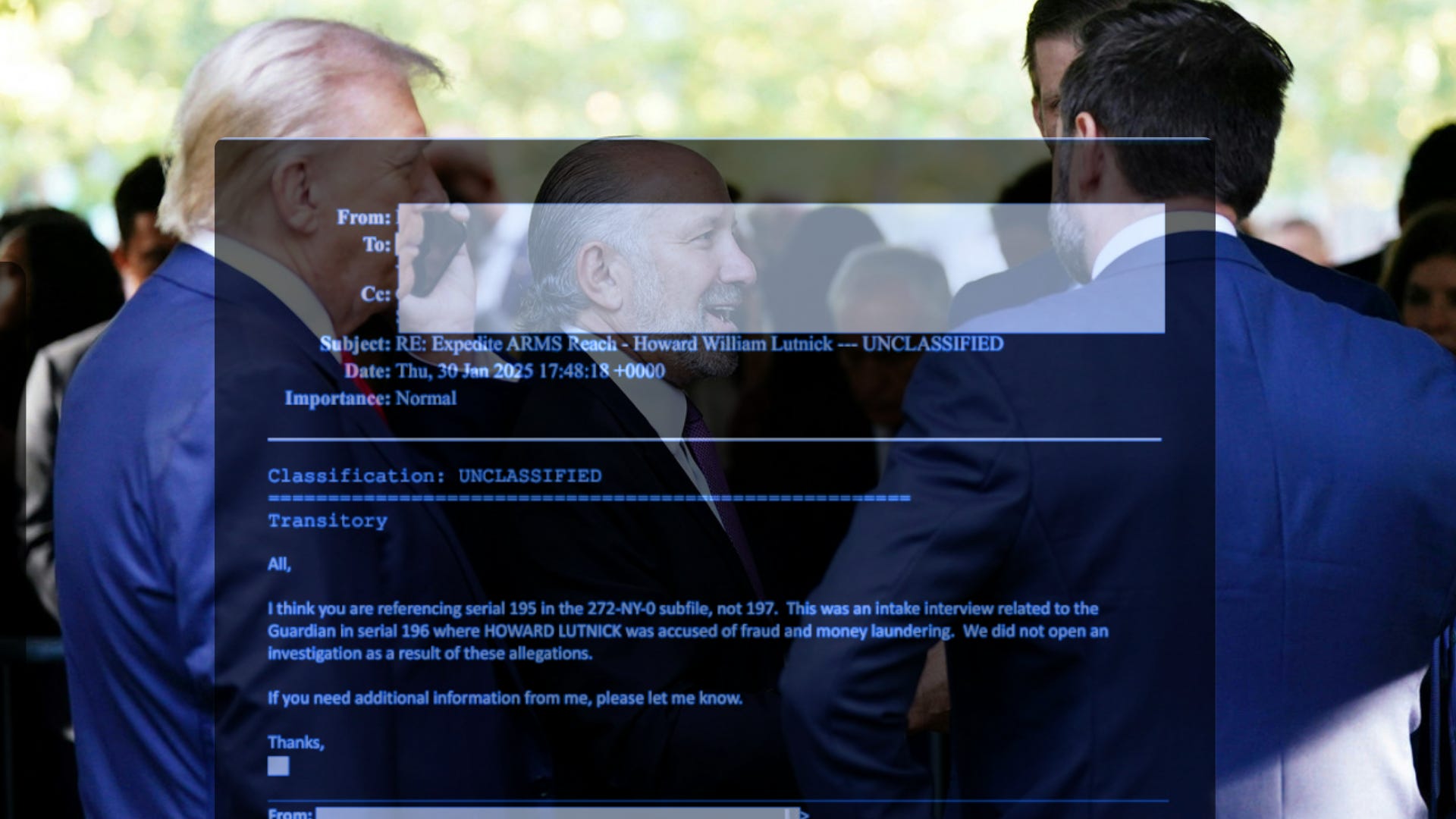
On January 30, 2025, an FBI analyst ran a routine security screening on Howard William Lutnick — Donald Trump’s nominee for Commerce Secretary — and hit two flags.
The first was in a money laundering case file, where Lutnick had been accused of fraud and money laundering in an FBI intake interview. The second was in case 50D-NY-3027571 — the FBI’s primary investigation into Jeffrey Epstein for child sex trafficking.
Nineteen days later, the Senate confirmed Lutnick by a vote of 51-45.
The document that reveals this — an internal FBI email chain now published through the Epstein file releases — is one of the most consequential records to emerge from the Epstein files. Not only because it alerts us to a possible criminal link between Epstein and Lutnick involving his 9/11 charity, but because of what it tells us about the FBI.
Lutnick Evidence in Two Cases
The screening was part of a program called ARMS Reach — the FBI and Secret Service protocol for vetting anyone who will be in direct proximity to the President of the United States. The FBI’s Enterprise Vetting Center runs the checks under federal statutes governing presidential protection. It is not a routine background check. It is a national security screening for access to the President.
At 12:15 PM that day, a Research Analyst in the Enterprise Vetting Center’s Special Vetting Unit 2 sent an email with the subject line:
“Expedite ARMS Reach - Howard William Lutnick --- UNCLASSIFIED.”
The analyst wrote that Lutnick was
“listed in the following [PENDING CASE(s)]”
and named them:
272-NY-0, Serial 197.
FBI case classification 272 designates money laundering. NY is the New York Field Office.
50D-NY-3027571, Serial 530.
This is the FBI’s central Epstein child sex trafficking investigation — the same case number that appears on hundreds of victim interviews, surveillance logs, and FBI reports released under the Epstein Files Transparency Act. It is one of the most significant sex trafficking cases in American history.
The analyst was assessing “facts which may bear on the suitability or trustworthiness of this individual to be in close proximity to POTUS” and noted the information would be shared with the United States Secret Service. The response was due within 24 hours.
Then the analyst added specific instructions
“Responses simply stating ‘No threat’ cannot be accepted, please provide a detailed summary of facts regarding any derogatory information on the stated subject.”
Don’t brush this off, the analyst was saying. If there’s something here, spell it out.
The Response
Five and a half hours later, a second FBI agent replied. The entire substantive response was this:
“I think you are referencing serial 195 in the 272-NY-0 subfile, not 197. This was an intake interview related to the Guardian in serial 196 where HOWARD LUTNICK was accused of fraud and money laundering. We did not open an investigation as a result of these allegations.”
The “Guardian” is likely the whistleblower who came to the FBI with accusations against Lutnick of fraud and money laundering. The FBI didn’t investigate.
And about the second case flagged by the analyst — Lutnick’s appearance in the Epstein child sex trafficking case? No response at all.
The Whistleblower
On October 19, 2020, a caller from the United Kingdom phoned the FBI’s National Threat Operations Center. The tip was logged under case 50D-NY-3027571 — the Epstein child sex trafficking investigation.
The caller said he had worked in New York from 2015 to 2017 for Cantor Fitzgerald and its subsidiary BGC Partners. He told the FBI that Howard Lutnick, CEO of Cantor Fitzgerald, was Jeffrey Epstein’s neighbor and “could be connected to Jeffrey Epstein.” He said he had witnessed “financial irregularities” and believed “some of the suspicious financial activities could be related to Epstein’s case.”
Then he went further. Cantor Fitzgerald lost 658 employees in the September 11 attacks, including Lutnick’s brother Gary. The firm’s annual Charity Day — in which all revenue from a single trading day goes to charitable causes — has been central to Lutnick’s reputation for over two decades. The whistleblower told the FBI he believed the charity day was fraudulent. He said he had documentation and had already submitted records to the Internal Revenue Service. He said Cantor Fitzgerald retaliated against him, causing him to suffer a heart attack and seven subsequent hospitalizations.
A second whistleblower tip, filed around the same period, reportedly went further. The caller claimed to have been responsible for regulatory compliance across all of North America at Cantor Fitzgerald and said he had uncovered “fraud, money laundering, Ponzi schemes and regulatory breaches.” The tip reportedly alleged that the trail “linked Howard Lutnick to illegal activities with JP Morgan, Russian Hedge Funds and other senior executives in the financial business.”
JP Morgan is not a new name in the Epstein story. Senator Ron Wyden and Narativ’s “The Greatest Heist” have extensively documented the bank’s role — including its CEO Jamie Dimon and former executive Jes Staley, whose personal relationship with Epstein continued long after his 2008 conviction. JP Morgan paid over $365 million to settle claims it facilitated Epstein’s sex trafficking through its banking services. A whistleblower placing Lutnick inside the same financial network is profoundly significant for the Commerce Secretary of the United States.
The FBI heard all of this. Its own documents prove it.
What Was Already Known
The ARMS Reach document didn’t emerge in a vacuum. The Epstein files had already demolished Lutnick’s claim that he cut ties with Epstein in 2005.
Emails and calendar entries show Epstein and Lutnick scheduling phone calls and drinks in 2011. In December 2012, Lutnick emailed Epstein to plan a visit to Little St. James — Epstein’s private island — bringing his wife, four children, another couple, and their four children. Eight children, ages 7 to 16, to the island of a convicted sex offender. Days later, the two men co-signed a shareholder contract for an advertising technology company called Adfin. In 2013, Epstein forwarded Lutnick legislation about Virgin Islands casinos, and a business associate emailed Epstein asking “What is your view on Howard Lutnick?” — treating the convicted pedophile as a reference. In 2017, Epstein ordered his money manager to send $50,000 to a UJA-Federation dinner honoring Lutnick — twelve years after the supposed cutoff. In 2018, Lutnick emailed Epstein about a Frick Collection renovation blocking “your sunlight and views.” And in May 2019, weeks before Epstein’s final arrest, an iMessage on Epstein’s phone read: “Trump is coming to Lutnick’s house Thursday.” Epstein replied: “I won’t be home otherwise I could have come out and waved.”
Confronted with some of this at a Senate hearing on February 10, 2026, Lutnick admitted for the first time that he had visited Epstein’s island. He then told senators: “I did not have any relationship with him. I barely had anything to do with that person.” The whistleblower reports suggest otherwise. They also prove the FBI did not investigate.
What the Document Proves
The FBI’s own vetting system for cabinet secretaries flagged Howard Lutnick in two case files involving serious criminal activity. In the first — a money laundering investigation — Lutnick was accused of fraud and money laundering. The FBI never investigated. In the second — the Epstein child sex trafficking case Lutnick was named but no details were provided. Someone potential involved in two crimes involving a convicted sex trafficker of children was declared no threat to the President of the United States.
Read the full documents below.
The ARMS Reach vetting document (EFTA00173881) and the FBI whistleblower tip (EFTA00020515) are available through the Department of Justice Epstein document releases.


Well Zev, there you go. Should never have been confirmed with those reports and now that he’s there Donald will protect him to the end. They all go down or none of them go down.
Wonderful reporting Zev! Why Lutnik is still in his post is beyond me