


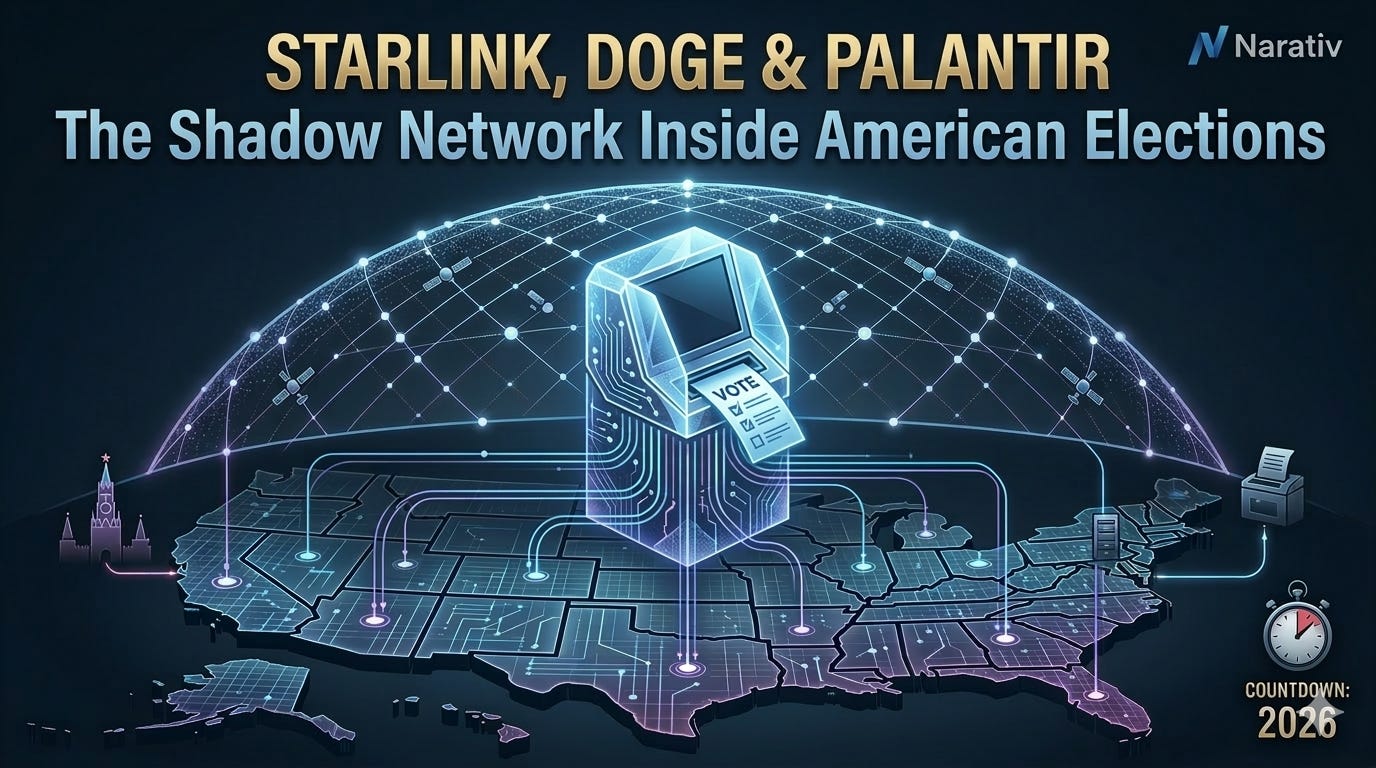
A Narativ investigation has connected the dots in what appears to be an operational network to interfere in the 2026 midterm elections — one that runs from the Kremlin through the highest levels of the U.S. government, through a privatized surveillance infrastructure, and now directly into America’s voter rolls.
The network is already active according to available evidence. Key actors are in place. Voters rolls are being acquired under false pretenses by the Trump regime and the Department of justice. The key actors are in place, and now we can reveal how the operation connects to The Kremlin, Palantir and Elon Musk. The countdown is on for November.
The Assignment
Last big break in our investigation came last week, Democracy Docket reported that DOGE has been formally assigned to review state voter rolls ahead of November’s midterm elections.
Read that carefully. Not the Justice Department. Not the Election Assistance Commission. Not any body with statutory authority over elections. DOGE — now a formal government department — whose own depositions, heard on Narativ Live just 24 hours ago, revealed an operation that ran on auto-delete Signal in violation of federal records law, used ChatGPT keyword lists to discriminate against minority-focused grants, and consolidated vast stores of government data into a single Palantir database, with credible evidence that DOGE has teh capacity to use Starlink infrastructure to move data outside government oversight.
Last year Elon Musk created DOGE in an apparent attempt to cut government fraud and waste by $2 Trillion. The project was a total failure by that measure, but it was used to consolidate Federal databases under a single Palantir framework. Now that same machine is targeting the last vestige of democratic rule.
The Seizure
It didn’t start with DOGE.
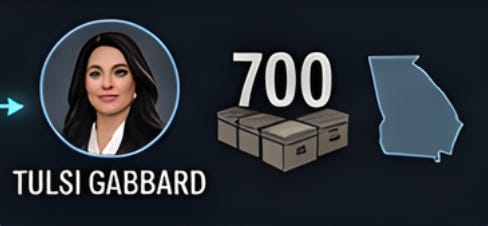
On January 28, 2026, Director of National Intelligence Tulsi Gabbard personally oversaw an FBI raid on the Fulton County Elections Hub in Union City, Georgia. Seven hundred boxes of voter rolls, ballots, and registration records were loaded onto trucks. Trump was on speakerphone with FBI agents during the operation.
Gabbard has no statutory authority over domestic law enforcement. Her predecessors took extraordinary pains to stay out of Justice Department cases. The FBI’s special agent in charge of the Atlanta office had been quietly fired the week before — with no public notice. The records seized were under judicial seal. They were taken anyway.
Senate Intelligence Committee Vice Chairman Mark Warner put it plainly: “Why is Tulsi Gabbard at an FBI raid on an election office in Fulton County?”
The answer, based on Narativ’s investigation, is that she was doing her job — just not the job that’s written in the statute.
U.S. intelligence assessments have identified Gabbard as a vector for Russian influence operations. She is not a passive actor. She is operational.
The Budget Cover
Russell Vought, Director of the Office of Management and Budget and chief architect of Project 2025’s executive power consolidation, provides the institutional framework that makes all of this look like governance.
His record is not ambiguous. During Trump’s first term, Vought withheld hundreds of millions of dollars in military aid to Ukraine — the act at the center of Trump’s first impeachment. He lobbied actively against NATO expansion for Finland and Sweden. He told the Financial Times that NATO’s collective defense should be “reassessed.” He is connected to Viktor Orbán’s national conservative network — the primary Russian influence vector into Western democratic institutions.
Vought doesn’t need to be a card-carrying operative. He provides the budget authority, the legal architecture, and the ideological cover. DOGE cuts what Vought approves. The voter roll review happens inside a budget framework Vought controls.
The Infrastructure

Narativ has been investigating the intersection of private surveillance technology and American election infrastructure for over a year.
Peter Thiel’s Palantir entered a partnership with Eaton Corporation — which controls power systems for approximately 70% of U.S. voting equipment — in May 2024. That partnership gave Palantir real-time access to operational data from the systems physically powering voting machines. Elon Musk’s Starlink Direct-to-Cell technology has the ability to connect to any LTE device without special hardware — including cellular modems present in voting equipment that is supposed to be air-gapped.
DOGE’s own depositions revealed that all consolidated government data flows into Palantir. One private company. One man’s company. God Access, insiders call it, to everything the federal government knows about every American.
Now add the voter rolls.
The Connector
Narativ’s reporting on the Epstein files establishes how this network was built.
Jeffrey Epstein introduced Peter Thiel to Sergey Belyakov — FSB Academy-trained, connected to sanctioned oligarch Oleg Deripaska, and director of Putin’s St. Petersburg International Economic Forum — in July 2015. Thirteen months before the election. Epstein arranged a meeting between Thiel and Russian UN Ambassador Vitaly Churkin in October 2016 — three weeks before Election Day.
Thiel went on to become Trump’s largest Silicon Valley donor, speak at the Republican National Convention, bankroll JD Vance into the Senate and then the vice presidency, and seed DOGE with his acolytes. Nate Cavanaugh — the Peter Thiel acolyte whose deposition Narativ examined yesterday — declared himself director of the U.S. Institute of Peace without being explicitly told to, terminated all its contracts and employees, and expressed no regrets whatsoever.
Thiel’s Palantir is now the consolidated data backbone of the United States government.
The Russian network didn’t need to infiltrate DOGE. It owns the the people who built it.
PAID SUBSCRIBERS CAN ACCESS A DEEPER DIVE BELOW:
