


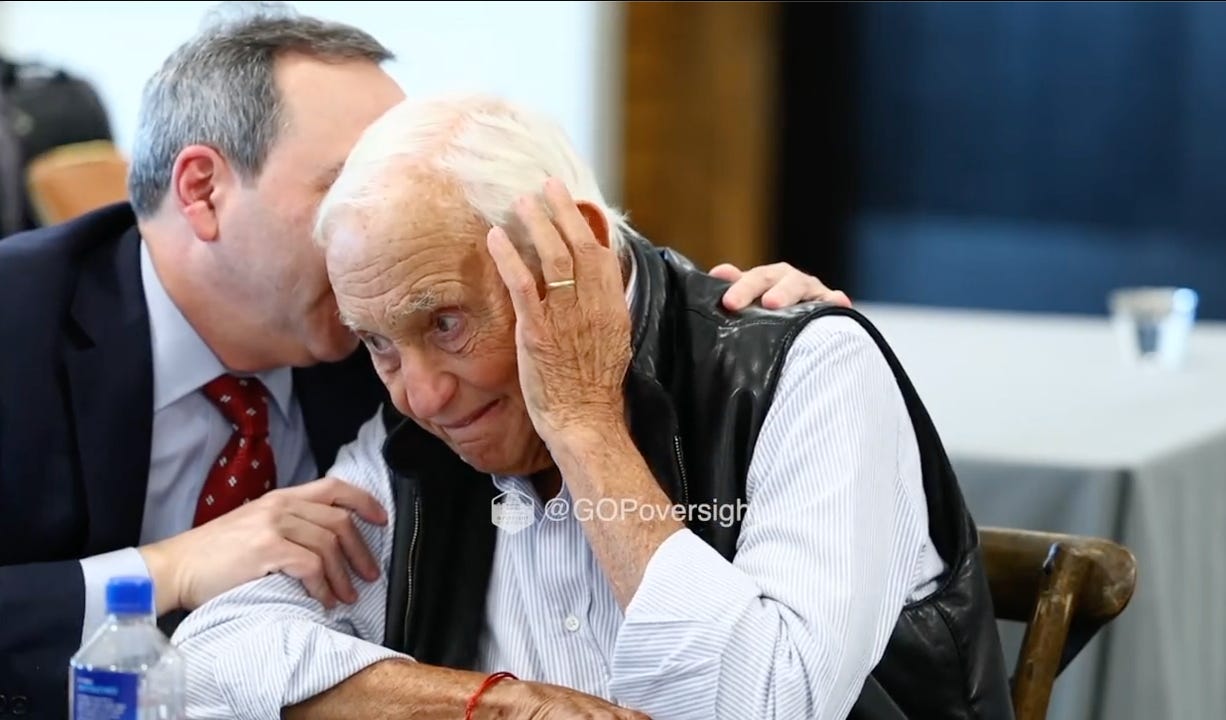
On Wednesday, February 18, Leslie Wexner sat before a House Oversight Committee deposition camera and did something no one in Jeffrey Epstein’s orbit has ever done. He talked. Not in the guarded, monosyllabic way his attorney Michael Levy wanted — five-word answers, nothing more. Wexner talked the way a man talks when he’s been hung out to dry by every other player in the network and has decided, at 88, that if he’s going down, he’s taking the names with him.
For nearly five hours, the billionaire founder of The Limited and Victoria’s Secret volunteered names, connections, and details that his own lawyer tried desperately to shut down. At one point, after Wexner had spent an extended stretch naming Rothschild, the Queen of England, the founders of Google, Jeff Bezos, the King of Saudi Arabia, and Abigail Johnson of Fidelity — his attorney Levy leaned in and whispered what he didn’t know was being picked up by a hot mic: “I’ll fucking kill you if you answer another question with more than five words, okay?”
Wexner laughed.
He kept talking.
What Wexner was doing wasn’t senility. He was alert, following every question precisely, and deliberately steering his answers into territory that his lawyer — and whoever texted that lawyer mid-testimony — did not want him to enter. A minute before the “kill you” moment, Levy received a message on his device. His whole demeanor changed. He stopped smiling. He looked concerned. Someone was watching in real time, and what they were watching was Wexner putting elite names on a congressional record under oath.
This investigation follows those names where they lead.
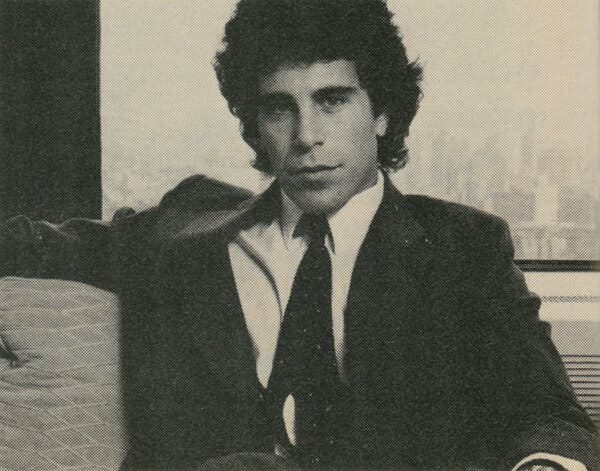
“I Spoke to Élie de Rothschild”
Of all the names Wexner dropped, one unlocks the rest.
When asked how he came to hire Jeffrey Epstein, Wexner testified that in 1987, he called Élie de Rothschild for a reference. “I spoke to Élie de Rothschild,” Wexner said under oath. “He represented their whole family.”
Élie de Rothschild — Baron de Rothschild, head of the French branch of the banking dynasty — vouched for a man who had been fired from Bear Stearns, had no financial license, and had spent the previous six years in Europe doing work that remains largely undocumented.
Those six years — 1981 to 1987 — are the black hole at the center of the Epstein story. Before he arrived in Wexner’s orbit, Epstein was operating in Europe alongside Douglas Leese, a British arms dealer who architected the Al-Yamamah deal, the largest arms sale in British history — a £43 billion pipeline of weapons to Saudi Arabia. Leese worked with Adnan Khashoggi, the Saudi arms broker, and Robert Maxwell, the media baron and alleged Israeli intelligence asset. Epstein carried an Austrian passport listing a Saudi residence.
When Epstein returned to America with a Rothschild endorsement, he wasn’t a financial advisor. He was an operative with connections to the arms trade, intelligence services, and European banking — and one of the world’s most powerful families had just given him the keys to American wealth.
The Rothschilds are not a single entity but a dynasty with branches across Europe, each surfacing differently in the Epstein story. The French branch produced Élie, who vouched for Epstein in 1987, and the Edmond de Rothschild Group, chaired by Ariane de Rothschild, who signed Epstein’s $25 million contract. The British branch produced Sir Evelyn de Rothschild, Queen Elizabeth II’s personal financial advisor, and his wife Lynn Forester de Rothschild, who introduced Prince Andrew to Epstein. The same branch produced Nathaniel Rothschild, who introduced Oleg Deripaska to British politicians — connecting the family directly to Russian oligarch money and Putin’s inner circle.
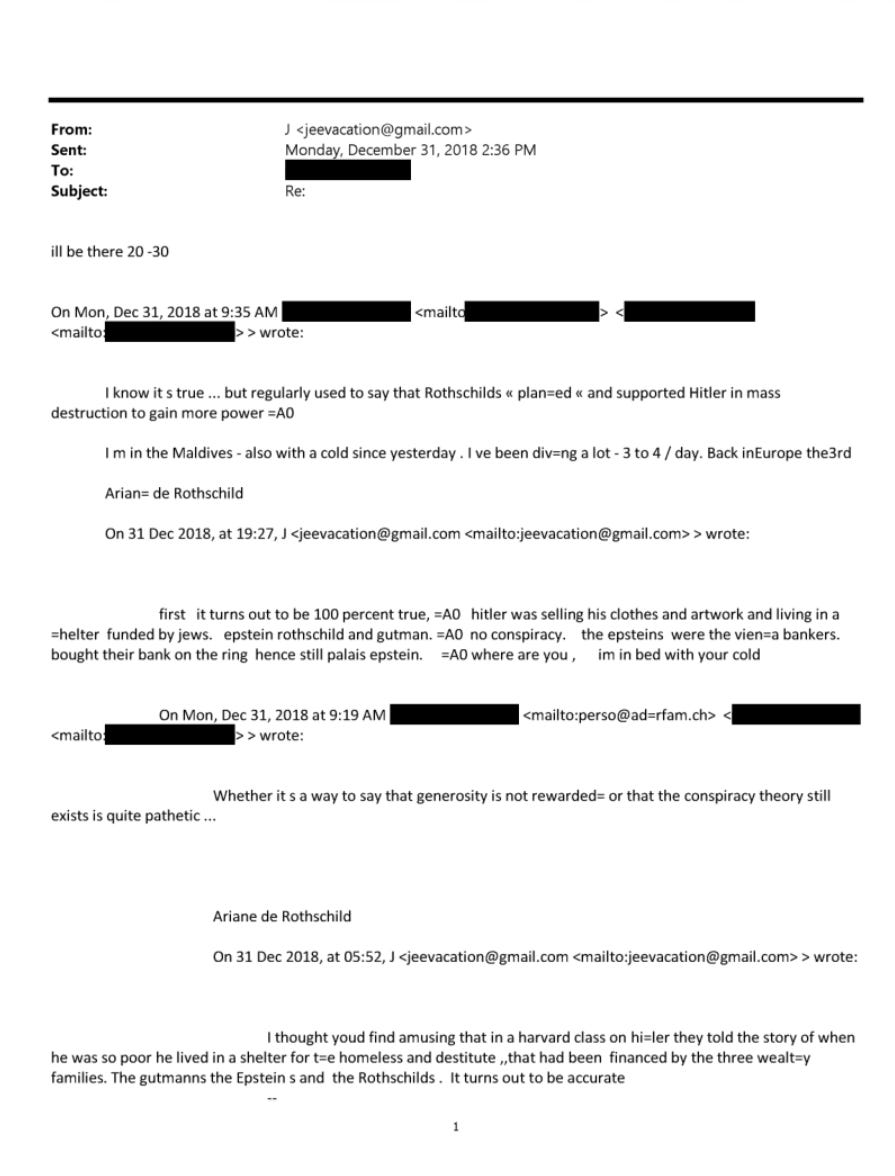
Epstein understood this architecture intimately. In a December 2018 email to Ariane, he described a Harvard class on Hitler’s years of destitution, during which the future dictator lived in a shelter funded by three wealthy Viennese families: “The Gutmanns, the Epsteins, and the Rothschilds.” Epstein added: “the Epsteins were the Vienna bankers. Bought their bank on the ring, hence still Palais Epstein.”
The Palais Epstein is real — an ornate building on Vienna’s Ringstraße, built by the banker Gustav Ritter von Epstein in the 1870s. Whether Jeffrey Epstein was actually descended from that family is unverified. But he made this claim directly to the chair of the Rothschild bank he represented — positioning his own family alongside hers as Viennese banking aristocracy. Ariane didn’t dispute it. She responded that she “regularly used to say that Rothschilds planned and supported Hitler in mass destruction to gain more power.” The day before, Epstein had forwarded the same story to Steve Bannon with the self-aware quip: “Not only billionaire pedophile friend of Trump but helped Hitler. Just what I need.”
Whether the bloodline claim was true or performance, it reveals how Epstein positioned himself within the network: not as an outsider who conned his way in, but as someone who belonged.
PAID SUBSCRIBERS CAN ACCESS A DEEPER DIVE BELOW:
