

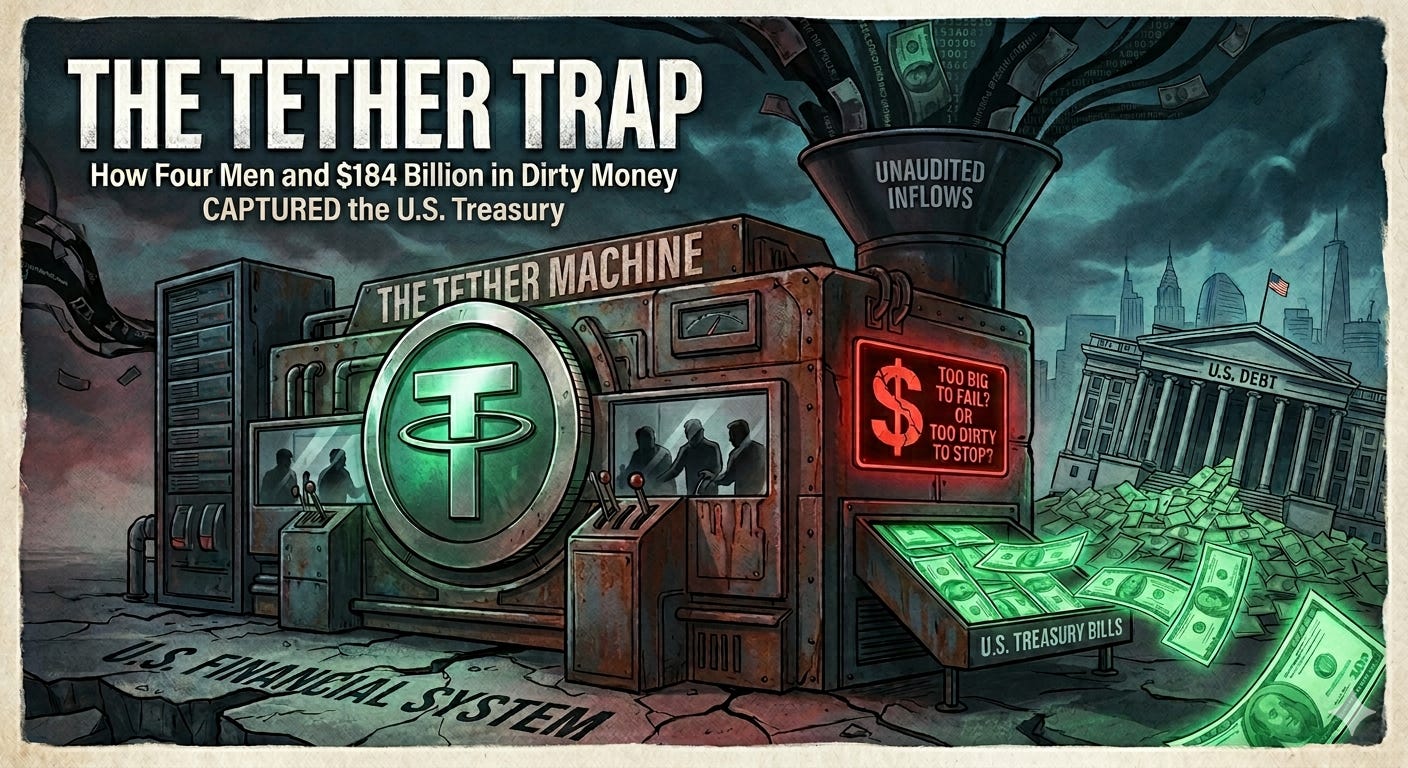
Four men you’ve never heard of control $184 billion in U.S. dollar-denominated assets — more than the GDP of Hungary. None of them are American. None of them have ever submitted to a full independent audit. And the United States government cannot shut them down without crashing its own Treasury market.
Their company is called Tether. And the money that built it is dirty.
I. THE MACHINE
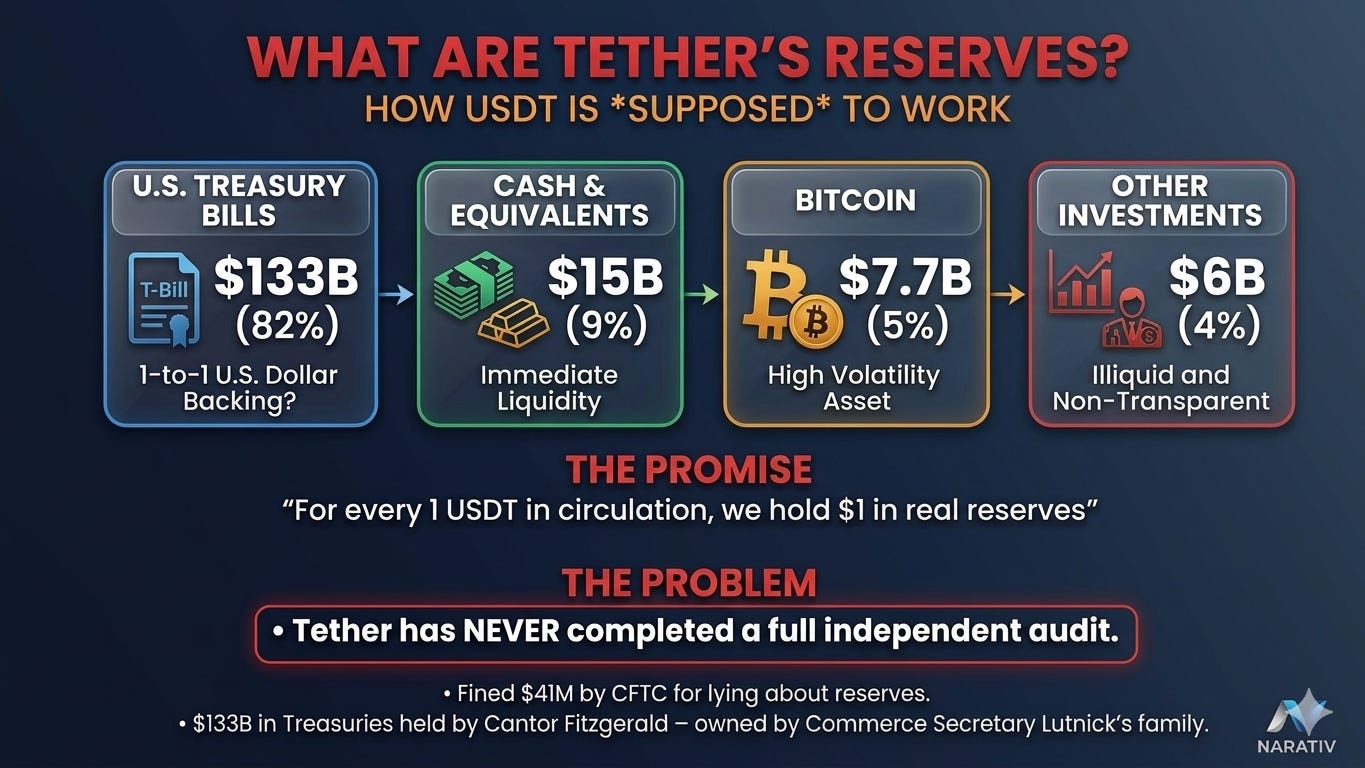
Tether is a stablecoin — a digital token pegged to the U.S. dollar. For every token issued, Tether claims to hold one dollar in reserve. At $184 billion in circulation, it is the largest non-sovereign holder of U.S. short-term Treasury bills on Earth — larger than the holdings of most allied nations. Those bills — $133 billion worth — are custodied by Cantor Fitzgerald, the Wall Street firm whose family ownership now depends on a loan from Tether itself.
The premise is simple: you give Tether a dollar, Tether gives you a token, and Tether buys a Treasury bill with your dollar. When you redeem the token, Tether sells the bill and gives you your dollar back.
But Tether doesn’t ask where your dollar came from.
II. WHERE THE DOLLARS COME FROM
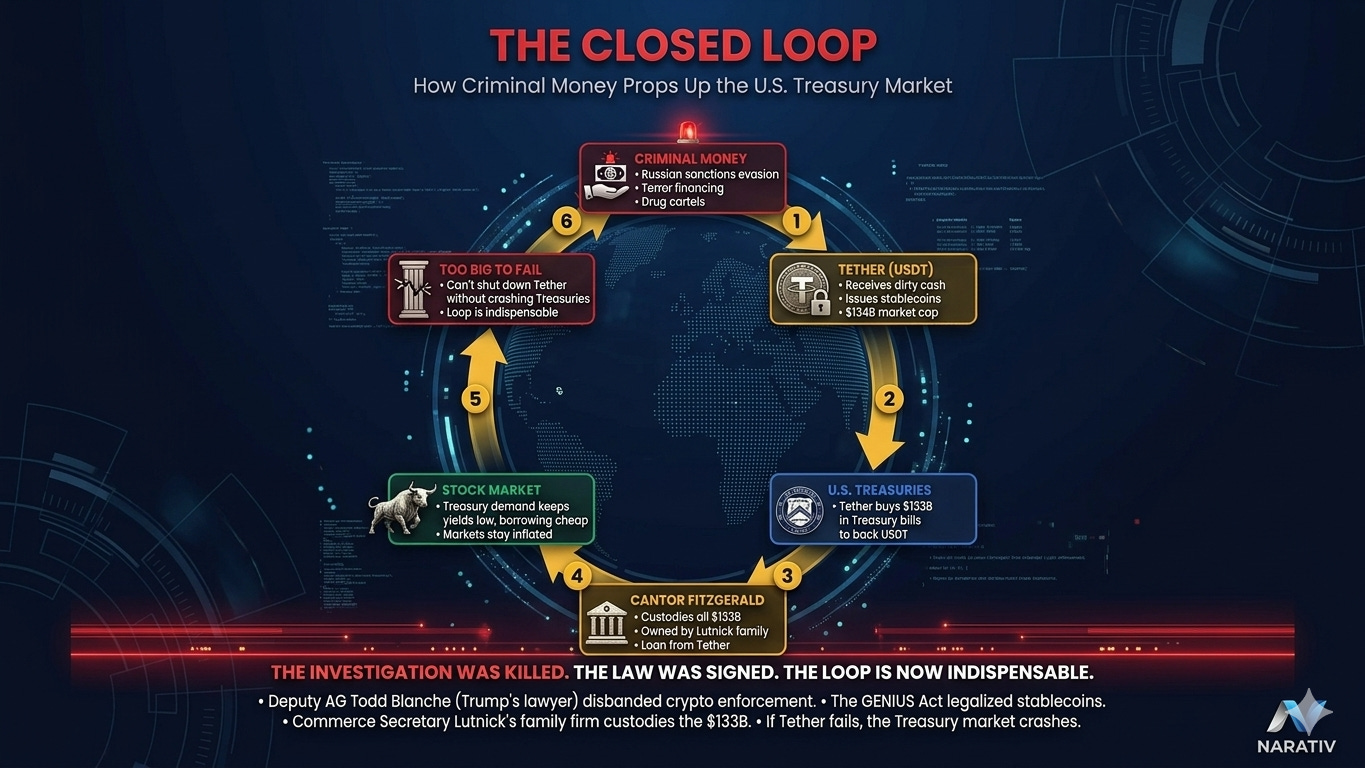
In September 2025, blockchain analytics firm Elliptic revealed that a network of crypto wallets tied to Russian state-linked entities had channeled over $8 billion through Tether’s USDT to systematically bypass Western sanctions. The funds moved primarily through the A7 Group, a company founded in 2024 with the explicit purpose of helping Russian firms conduct cross-border trade. A7 is 49 percent owned by Promsvyazbank — a sanctioned Russian state bank that funds Moscow’s defense sector.
That $8 billion is one network. There are others.
Reuters reported in March 2025 that Russian oil companies are converting yuan and rupees from Chinese and Indian oil sales into USDT, then exchanging it for rubles inside Russia. One trader alone conducts tens of millions in monthly crypto transactions. This is how Russia keeps its $192 billion annual oil trade flowing despite Western sanctions. Tether is the pipe.
The U.S. Department of Justice charged Russian national Iurii Gugnin with laundering approximately $530 million through U.S. banks and cryptocurrency exchanges — primarily USDT — in a scheme run from a Manhattan office. A self-described Russian smuggler in China used Tether to pay a Hong Kong electronics distributor for drone parts ordered by the U.S.-designated Kalashnikov Concern, the manufacturer of the weapons Russia is using to kill Ukrainians.
Garantex, the Russian crypto exchange sanctioned by the U.S. Treasury Department, processed $96 billion in transactions between 2019 and 2025 — overwhelmingly in USDT on the TRON blockchain. When the U.S. Secret Service seized its domains in March 2025, it reappeared within days as Grinex, Exved, and MKAN Coin. The infrastructure doesn’t die. It metastasizes.
A United Nations report described USDT as “the primary instrument for criminal activities and money laundering in Southeast Asia.” Senator Elizabeth Warren, in a letter to Commerce Secretary nominee Howard Lutnick in January 2025, documented Tether’s role in financing North Korean nuclear weapons programs, Mexican drug cartels, Russian arms companies, Middle Eastern terrorist groups, and Chinese manufacturers of fentanyl precursor chemicals.
Tether has been fined $41 million by the CFTC for lying about its reserves and $18.5 million by the New York Attorney General for the same offense. It has never completed a full independent audit.
That is the machine. Criminal money in. Treasury bills out.
Paid Subscribers Can Access A Deeper Dive
