


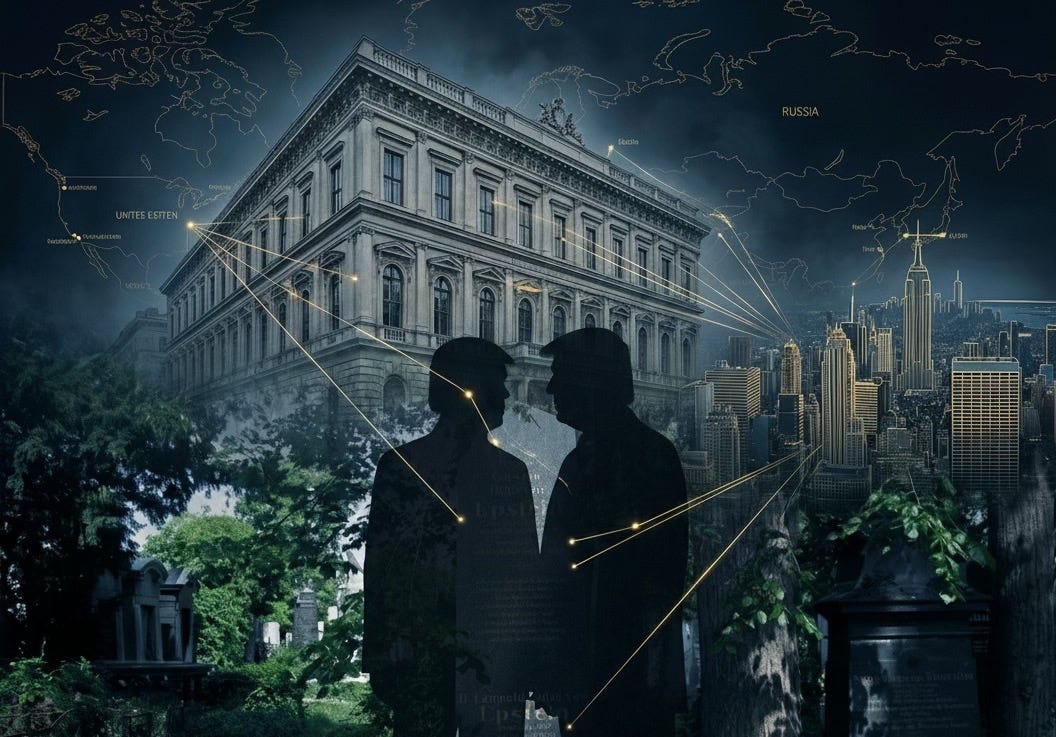
For fifteen years, Donald Trump and Jeffrey Epstein were best friends. They partied together in Palm Beach and Manhattan. They were photographed together, quoted praising each other, and linked in the tabloids. That friendship — and what it may have involved — has dominated the Epstein story since the files began dropping in January.
But the millions of pages released by the Department of Justice this year, combined with Leslie Wexner’s explosive testimony under oath on February 18, reveal something more significant than a friendship. They reveal that Trump and Epstein were not two men who happened to know each other. They were two men built by the same financial dynasty — a dynasty with a two-hundred-year history of building exactly this kind of network.
The Dynasty
To understand what the Epstein files have exposed, you have to understand the Rothschilds — not as an antisemitic trope, but as a specific, documented, two-century-old banking operation with a specific business model.
The Rothschild family built its fortune through a pattern that has repeated across every major financial crisis since the Napoleonic Wars. In 1825, when the Bank of England faced a liquidity crisis, it was the Rothschilds who supplied the gold to avert collapse — making the family indispensable to British finance. In the crash of 1873, while every other major bank in Vienna was destroyed, the Rothschild-founded Creditanstalt was the only institution left standing. It absorbed the market. By 1913, Creditanstalt’s assets equaled the entire Austrian state budget. In 1890, when Barings — then the most powerful bank in London — faced ruin, the Rothschilds organized the rescue on terms that permanently subordinated their rival.
The pattern is always the same. Finance the boom. Survive the crash. Consolidate during the wreckage. The family doesn’t just weather crises. It emerges from them stronger, having absorbed the clients, the assets, and the influence of everyone who didn’t survive.
N.M. Rothschild & Sons set the daily gold price in London for nearly a century. Rothschild & Co is consistently ranked among the top ten global investment banks for mergers and acquisitions. Sir Evelyn de Rothschild served as the personal financial advisor to Queen Elizabeth II. The family’s advisory business, restructuring practice, and wealth management operation span over forty countries.
This is not conspiracy. This is the documented history of a financial institution that has operated continuously since 1798. And in the 1980s, two branches of this dynasty made two decisions that would converge, decades later, in the same White House.
Their Man: Epstein
On February 18, 2026, Leslie Wexner — the richest man in Ohio, the founder of Victoria’s Secret — testified under oath before the House Oversight Committee. The FBI had named him an unindicted co-conspirator. At eighty-eight, he decided to talk.
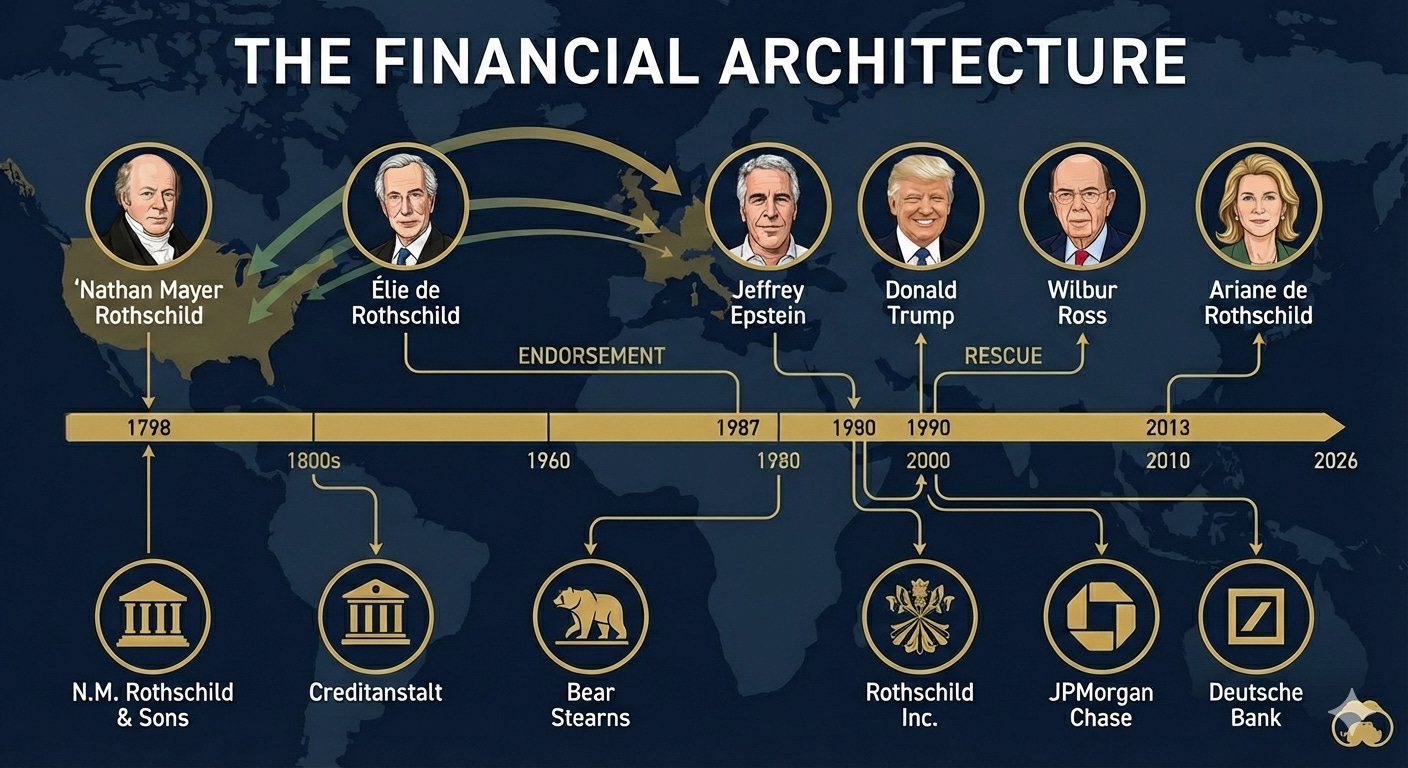
In his prepared statement, Wexner named every person who endorsed Jeffrey Epstein before Wexner hired him. There were three. Two were from Bear Stearns — chairman Ace Greenberg and future CEO Jimmy Cayne, who “endorsed Epstein without hesitation.” The third was from the Rothschild dynasty.
“Epstein also offered a reference, Élie de Rothschild,” Wexner said. “When I spoke with Élie, he highly recommended Epstein based upon work Epstein had done for his family.”
Élie de Rothschild — Baron de Rothschild, head of the French branch of the banking dynasty — personally vouched for a man who had been pushed out of Bear Stearns, had no financial license, and had spent the previous six years doing undocumented work in Europe alongside arms dealers and intelligence-connected figures. Epstein carried an Austrian passport listing a Saudi residence. He had no visible clients, no public track record, and no credentials.
And yet one of the most powerful bankers in the world picked up the phone and told the richest man in Ohio to trust him.
That endorsement opened everything. Within four years, Epstein held Wexner’s power of attorney — total control over a billion-dollar fortune. He embedded himself in the Ohio business network that would eventually feed into JPMorgan Chase. He became a director of the Wexner Foundation. He ran the real estate development of New Albany. He even relocated a CIA-linked cargo airline — Southern Air Transport, the Iran-Contra airline — to Columbus to ship clothes for Wexner’s retail empire. Customs agents found cocaine on one of its planes in 1996.
The Rothschild relationship didn’t end in 1987. It deepened across decades and branches of the family. By 2015, Epstein had signed a $25 million contract with Ariane de Rothschild’s Edmond de Rothschild Holding. He exchanged over five thousand emails with Ariane. He brokered introductions between the Rothschilds and Wall Street’s largest private equity firms. He told Peter Thiel in 2016: “As you probably know, I represent the Rothschilds.” He told Ariane herself that “the Epsteins were the Vienna bankers” — a reference to Gustav Ritter von Epstein, who built the Palais Epstein on Vienna’s Ringstraße in the 1870s, right next to Parliament. The same crash of 1873 that destroyed Gustav’s bank made the Rothschild-founded Creditanstalt the last institution standing.
His relationship with the Rothschild dynasty was real, deep, and sustained from 1987 until the year before his death. And newly released files show he didn’t just work with banking aristocracy — he operated as part of it.
But newly released documents from the Epstein files — never before reported — reveal something remarkable. Whether Jeffrey Epstein was truly descended from the Viennese Epstein banking dynasty has not been proven. But the documents show it doesn't matter. He was accepted by European banking aristocracy — by diplomats, professors, royalty, and the Rothschilds themselves — as one of their own.
PAID SUBSCRIBERS CAN ACCESS A DEEPER DIVE BELOW THE PAYWALL AND CAN SCRUTINIZE THE VON EPSTEIN DOCUMENTS
