Narativ with Zev Shalev

Narativ with Zev Shalev

The Greatest Heist

THE GREATEST HEIST: ATOMIC SPY

BONUS CHAPTER: The Real Business Was Always the Bomb

Zev Shalev's avatar
Zev Shalev
Apr 21, 2026
∙ Paid

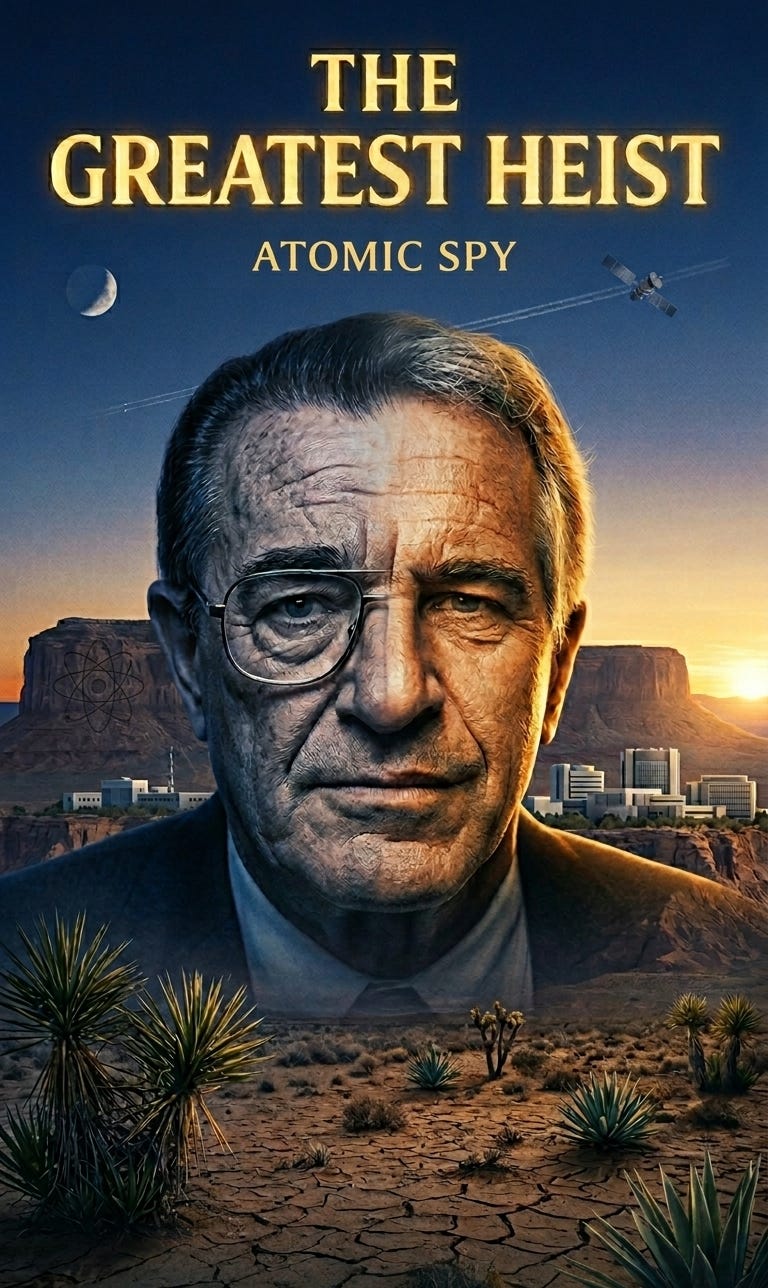
Jeffrey Epstein claims New Mexico drew him after 1990 — not for the land itself, but for the knowledge clustered there. The valley between the Sangre de Cristo and Sandia mountains is the birthplace of the atomic age. Physicists and mathematicians drift out of Los Alamos into private startups and the Santa Fe Institute. Zorro Ranch, he says, was no accident; he places it 23 miles from the Institute and 50 miles from Los Alamos.

He endows a chair at the Institute, named for Robert Maxwell.


Nuclear weapons are designed not to be used - built on the concept of Mutually Assured Destruction (MAD). Every warhead in a Wyoming silo, every Trident missile under the Pacific, every gravity bomb on a B-2 — none are meant to be used. They are meant to be feared.

As in, “You’d be MAD to use them.”

The Soviets understood by the mid-1970s that they could not out-build, out-miniaturize, or out-submarine America. The gap was unbridgeable but as long as each side had enough to destroy the other, a peace of sorts would prevail.

What they feared is what they couldn’t see.

Nuclear secrets were always the game. It was Robert Maxwell’s first assignment

In the Spring of 1945 in a German interrogation room - a 22-year-old Czech Jewish officer — brave, brilliant, family lost to the Nazis — was handed a dossier: Alsos. The order: find out what Heisenberg knew.

Six years after Alsos, Maxwell pitches British intelligence. The Soviets are flooding the world with physics and engineering journals. Nobody in the West is translating them. Maxwell offers. MI6 signs off. In 1951 he takes Pergamon Press, flies to Moscow, signs an exclusive copyright deal with VOuAP, and secures the right to translate Soviet science into English. The deal gives him decades of cover to sit inside rooms with Soviet nuclear physicists.

If you're asking the right question: the answer is a triple agent. His loyalty tree was Russia, Israel, and only then, British.

It was enough to catch the attention of the FBI. On December 9, 1953, J. Edgar Hoover signs a memo on Maxwell. Four words headline the page.

INTERNAL SECURITY — R & GE

R is Russia. GE is General Espionage. The case file is 105-25063.

“Bureau files contain no information identifiable with subject,” Hoover writes. “It is desired that you obtain through your sources identifying data and information concerning subject’s travels to the United States.”

By the end of 1953, the FBI has classified Maxwell as a Russian espionage subject moving toward the American atomic establishment.


Maxwell lands at Idlewild on April 1, 1954, on Pan American Flight 101. The FBI has asked Customs and Immigration to flag him at every East Coast port of entry. Pan Am treats him like a prince — the London cable reads

“GIVE HIM THE BEST OF SERVICE AS HE IS FREQUENT PAN AMERICAN AIR LINE TRAVELER.”

The customs lookout fails. He catches his 7:15 connection to Toronto.

Seven months later, he is back. This time the FBI listens in real time through the Atomic Energy Commission’s switchboard.

“ON OCTOBER TWENTYSEVEN LAST SUBJECT TRIED TO REACH DR. ALVIN WEINBERG, TECHNICAL DIRECTOR OF OAK RIDGE NATIONAL LABORATORY, AND DR. L. HAWORTH, TECHNICAL DIRECTOR OF BROOKHAVEN NATIONAL LABORATORY. ON OCTOBER TWENTYEIGHT LAST SUBJECT CONTACTED BY TELEPHONE DR. WALTER ZINN, DIRECTOR OF ARGONNE NATIONAL LABORATORY, LEMONT, ILLINOIS.”

Weinberg runs Oak Ridge, where uranium for the Hiroshima bomb was enriched. Haworth runs Brookhaven, the AEC’s flagship Long Island research facility. Zinn runs Argonne, where Enrico Fermi built the world’s first reactor. Inside forty-eight hours Maxwell reaches all three of them, plus John von Neumann, newly appointed to the AEC itself.

A McGraw-Hill editor named J. H. Luntz lays out Maxwell’s pitch to an FBI agent a few days later:

“MAXWELL’S plan is to have ZINN or HAFSTAD to be Editor in Chief of the American atomic energy magazine and planned that the Directors of the AEC National Laboratories would be Editors. MAXWELL would set up a fifteen man Editorial Board of American scientists… No renumeration would be involved… MAXWELL’S company would cover the entire costs on a monthly basis.”

A fifteen-man editorial board of every AEC national-lab director. Writing for free. In a journal owned by a Czech-born British publisher who has just signed an exclusive copyright deal with Moscow.

An access list.

On October 29, 1954, Maxwell sits for an interview at AEC headquarters. He confirms the pitch in writing:

“MAXWELL INDICATED HE WAS IN US ON BEHALF OF THE ABOVE JOURNAL… SUBJECT IS WORKING WITH DR. J. V. DUNWORTH OF HARWELL, ENGLAND.”

Harwell is the British equivalent of Oak Ridge. Dunworth is the deputy to Cockcroft, the Nobel laureate who runs it.

The FBI writes it all down. Then closes the case. File 105-25063 goes to storage for thirty years.

But the operation endures. Through Maxwell’s daughter, and her partner Jeffrey Epstein. Pergamon is gone but the funding of scientists - that persists through the Program for Evolutionary Dynamics at Harvard, through Martin Nowak, through MIT Media Lab via Marvin Minsky, through dinners at Zorro halfway between Los Alamos and Sandia, and through a chair at the Santa Fe Institute that he endows and names for Robert Maxwell.

Epstein’s hat tip to the past leaves Robert Maxwell’s name on the door. The scientists change as the decades pass. The operation does not.


I ask Ari Ben-Menashe in 2019 when he first met Jeffrey Epstein.

Ben-Menashe: “It was 1981. Maxwell had to introduce him to us. He wanted us to accept him as part of our group.”

The group is a cell of Israel’s Directorate of Military Intelligence. Ben-Menashe is a senior operative. The press has always said Mossad. Ben-Menashe corrects me on tape.

Ben-Menashe: “I was in this group of military intelligence. They keep on saying Mossad — that’s not it.”

I ask what Maxwell said when he pushed Epstein in.

Ben-Menashe: “Your Israeli bosses have already approved. It came down from up above.”

Ben-Menashe did not think Epstein was competent for arms work. But Maxwell, he says, had a different reason.

Ben-Menashe: “He was a good-looking guy. And Miss Maxwell — she fell for him.”

I ask about Ghislaine directly. Was she an agent too?

Ben-Menashe: “Oh, definitely. Military intelligence as well.”

A senior Israeli Directorate of Military Intelligence operative, on video, identifying Jeffrey Epstein and Ghislaine Maxwell as assets of the same service he worked for. Why would Israeli intelligence want to blackmail Americans?

Ben-Menashe: “These guys were seen as agents. They found the niche for themselves. Blackmailing American and other political figures. It was quite their M.O.”

Then he laughs.


I bring up PROMIS in the first hour. The DOJ’s case-management software walked out of the Justice Department in 1982 and ended up running, bugged, inside central banks and nuclear facilities on every continent. No convictions. No names.

Ben-Menashe: “Yes. We were the ones that gave it to him, and he gave it to the Russians. And sold it to everybody else around the world.”

I press on the theft. Two people went in. Who was the second? Ben-Menashe won’t say his own name, but drops the name of the man who wrote it: “I know Hamilton. I know Hamilton. I know what I’m doing.”

Later, over the phone, Ben-Menashe admits he was the second man. He went, under cover, into a building of the United States Department of Justice. He came out with the software. He handed it to Robert Maxwell.

Maxwell put a backdoor into it.

Ben-Menashe: “The PROMIS was sold to the GRU. And sold to everybody else around the world.”

One PROMIS installation Maxwell sold was in New Mexico.


Ben-Menashe wasn’t the only Israeli spy working on nuclear secrets.

Arnon Milchan’s office is on Sunset Boulevard. He is producing Brazil for Terry Gilliam and preparing Once Upon a Time in America for Sergio Leone. To everyone who calls him, he is Hollywood’s rising producer.

The calls that matter come from Richard Kelly Smyth, an engineer in Huntington Beach who runs a small company called MILCO International. MILCO ships electronic components through Heli Trading — a front for the Israeli Ministry of Defense.

The components are krytrons. A krytron is about the size of a pen cap. Under high voltage, it’s the fast-firing switch that detonates the plutonium implosion lenses inside a nuclear warhead.

Between 1980 and 1983, MILCO ships 810 krytrons to Israel.

Smyth’s contact at the Israeli Embassy in Washington, during the shipments, is the deputy chief of mission. His name is Benjamin Netanyahu.

Federal prosecutors indict Smyth in 1985. He flees to Spain. Netanyahu is never charged.

November 2013: on Israeli television program Uvda, Arnon Milchan confesses that the entire krytron operation was run by him, for Israeli military intelligence, under cover of a Hollywood production company. The confession appears in his 2011 authorized biography two years earlier.

Then-Prime Minister Benjamin Netanyahu appears on the same broadcast.

“Arnon is a long-time intelligence asset,” Netanyahu says. “He contributed enormously to the security of the state.”

The security of the state, in diplomatic Hebrew, means the bomb.May 25, 1984. The FBI’s San Francisco field office opens and closes an investigation into a Berkeley, California information firm called Information On Demand, Inc. Its new owner, as of 1982, is Robert Maxwell, through Pergamon International.

Two weeks later, employees of the National Security Agency walk into the FBI’s Albuquerque field office and describe the same company. The Albuquerque SAC cables FBI Headquarters in a SECRET airtel:

“The information provided by [REDACTED] was received from employees of the National Security Agency (NSA) and has to do with the purchase of Information On Demand, Inc., by one ROBERT MAXWELL, the owner of Pergamon International, a British information firm.”

The NSA employees have flagged the acquisition as connected to “various available means of tapping government information data bases.”

Tapping government information data bases.

This is June 1984. Two years after Ben-Menashe walked PROMIS out of the DOJ. One year after Maxwell sold the backdoored software to the GRU.

On July 19, 1984, the FBI Director cables both offices and connects them as the same target.

Then Headquarters supplies Albuquerque with the reason to close:

“this might be dated information which relates to the data furnished by FBIHQ concerning the severing of the rights to the data base by Pergamon and the breaking of the data exchange agreement.”

In other words, Washington has told Albuquerque the problem is already solved. The tip is dated.

Albuquerque accepts the framing. Closes the case.

“Until such time as NSA re-establishes contact and expresses further interest in this matter, Albuquerque is taking no further action and this matter is being placed in a closed status.”

And:

“The personnel at Sandia National Laboratories were told that if NSA has a desire to establish contact with the FBI in this matter, a logical step would be to contact FBIHQ and pursue it through that channel.”

The Sandia personnel are told, in writing, that the National Security Agency is no longer welcome to walk into the local FBI field office about a British publisher tapping American databases. Any NSA contact must route through Washington.

“There is a chance they will come to Albuquerque in September,” the cable adds. “If this occurs, FBIHQ will be apprised of any pertinent data received.”

If the NSA shows up again, Washington is notified.

The American intelligence apparatus raised the alarm. Washington buried it, and then Washington surveilled the alarm-raisers.


While the FBI closes the Maxwell case, a U.S. Navy civilian analyst named Jonathan Pollard photocopies 800,000 pages of classified material and hands them to a handler at the Israeli Embassy. The material includes the acoustic signatures of American nuclear submarines.

American boomer submarines — the Ohio-class Trident platforms — are the most survivable leg of the nuclear triad. They exist to be undetectable. Hand an adversary their acoustic signatures and the deterrent collapses.

Pollard delivers. The embassy sends to Tel Aviv. Tel Aviv, multiple U.S. inspector general reviews later conclude, sends onward to Moscow.

The Soviets already have PROMIS.

Now they have the noise profiles of the submarines carrying the warheads PROMIS is helping them map.


1986. Maxwell is in the Mirror building on Holborn when his secretary tells him the Israeli Embassy is on line two.

His editors at the Sunday Mirror have been fielding an approach for three weeks from Mordechai Vanunu, a former Dimona technician who worked for a decade inside Machon 2, the underground plutonium-production building. Vanunu has photographs and diagrams.

Maxwell picks up. He tells the Embassy what the Sunday Times has, what the Mirror has been offered, and when the material will publish.

Within days, a Mossad honeypot named Cindy meets Vanunu in London and lures him onto a flight to Rome, where Israeli security ties him to a stretcher and flies him home. He will spend eighteen years in Ashkelon prison, mostly in solitary.

Maxwell protects the warhead program.

PAID SUBSCRIBERS CAN ACCESS A DEEPER DIVE BELOW THE PAYWALL

User's avatar

Continue reading this post for free, courtesy of Zev Shalev.

Or purchase a paid subscription.
© 2026 Zev Shalev · Privacy ∙ Terms ∙ Collection notice
Start your SubstackGet the app
Substack is the home for great culture