


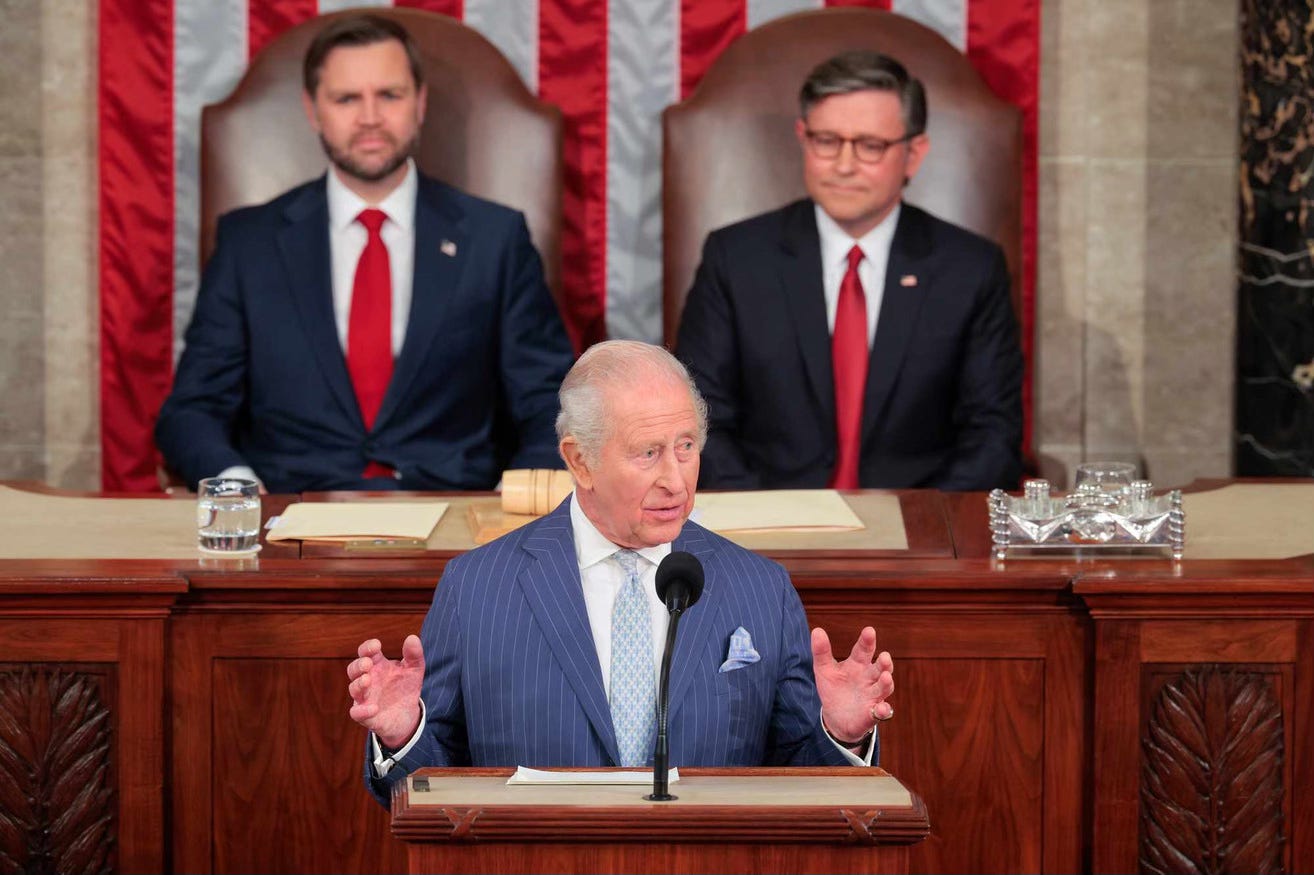
Two reigning British monarchs have addressed a Joint Meeting of the United States Congress: Queen Elizabeth II in 1991, at the dawn of an American century she still believed in, and King Charles III on Tuesday, April 28, 2026, watching America combust under the weight of a president whose compounding failures have led him to the lowest favorability ratings in his two presidential terms.
Thirty-five years between the two speeches. The chamber was unchanged: Freedom overhead, the flag behind the Speaker, the 119th Congress filling the seats. Both parties were present, the cabinet and diplomats in place, the Joint Chiefs in dress blues.
Howard Lutnick beamed in the front row.
Donald Trump was left to watch the whole thing from the White House, unmentioned even once. Whether he grasped the speech’s carefully coded critique is anyone’s guess.
But it was the speech we’d all longed for — one denied by Trump’s mob-land version of democratic government.
The King took no direct shots — he’s too smart for that — instead grounding his speech in the founding documents his nation bequeathed to America at our founding.
He cited Magna Carta. He named the principle that executive power is subject to checks and balances. He invoked the Declaration of Rights of 1689, the Bill of Rights of 1791, and the Spirit of 1776. He reminded Congress that America’s founding principle came from a fundamental disagreement with Britain — a disagreement that forged a lasting partnership.
He condemned the recent perimeter skirmish at the White House Correspondents Dinner, declaring, “Such acts of violence will never succeed.” He praised diversity, faith, the climate, the rule of law, and the independent judiciary.
He invoked support for Ukraine, earning bipartisan applause from a Congress bitterly divided on the issue.
He closed on Lincoln, quoting the Gettysburg Address:
“May little note what we say, but will never forget what we do.”
Lincoln invoked; Trump never mentioned.
He blessed both nations.
The joint session sprang to its feet for several ovations. For a brief moment, sense and sensibility were restored to the chamber. It was a gentle reminder of what it means to be a parliamentarian and of who we used to be.
Some might call it routine — a state visit, a ceremonial address. But Charles spoke of grounding principles: liberty, equality, justice, democracy — that Trump views as impediments, not virtues.
“Whatever our differences, whatever disagreements we may have, we stand united in our commitment to uphold democracy, to protect all our people from harm…”
It was the type of blunt message only a friend can deliver to the representatives of the American people - while hoping it skates over the head of the man who inspired it. The King put the United States on notice — you can only meddle with democracy so much. And no more. After that, you lose your connection to your roots.
PAID SUBSCRIBERS CAN READ THE FULL TEXT OF THE SPEECH AND GET A DEEPER DIVE BELOW
