



Many of you expressed reservation when I included Michael Cohen in our post- Trump coverage. I asked him on precisely because I wanted to ask him questions about Trump and Epstein.
The questions weren’t unusual. They’re what any journalist would ask someone who worked as Trump’s personal lawyer and fixer from 2006 to 2018, covering both the Katie Johnson rape case filing and the suspicious $95 million Maison de l’Amitié sale to a Russian oligarch. These are the best known intersections of Trump and Epstein, and Cohen worked for Trump during both events.
Cohen’s response reveals something more interesting than his answers.
THE KATIE JOHNSON CONTRADICTION
During Wednesday’s panel, Cohen stated he “never worked on the Katie Johnson matter”—that Alan Garten handled it. But Cohen then described investigating what he called a different “Jane Doe case” involving “an infant” that his investigation determined was fake.
Court records tell a different story.
There is one Jane Doe case involving Trump and Epstein rape allegations: Katie Johnson. Filed in 2016, an adult woman alleging abuse at age 13 in 1994, using the pseudonym “Jane Doe.” The case was withdrawn in November 2016 after the plaintiff received death threats.
A search of federal and state court databases reveals no second case matching Cohen’s description—no infant, no separate Jane Doe filing, no case with a similar timeline.
Either Cohen was working on the Katie Johnson case—contradicting his sworn statement that he “never dealt with” it—or he’s describing a case that doesn’t exist in court records.
When asked Thursday morning to clarify which case he investigated and provide documentation, Cohen declined to respond.
THE MAISON DE L’AMITIÉ CLAIMS
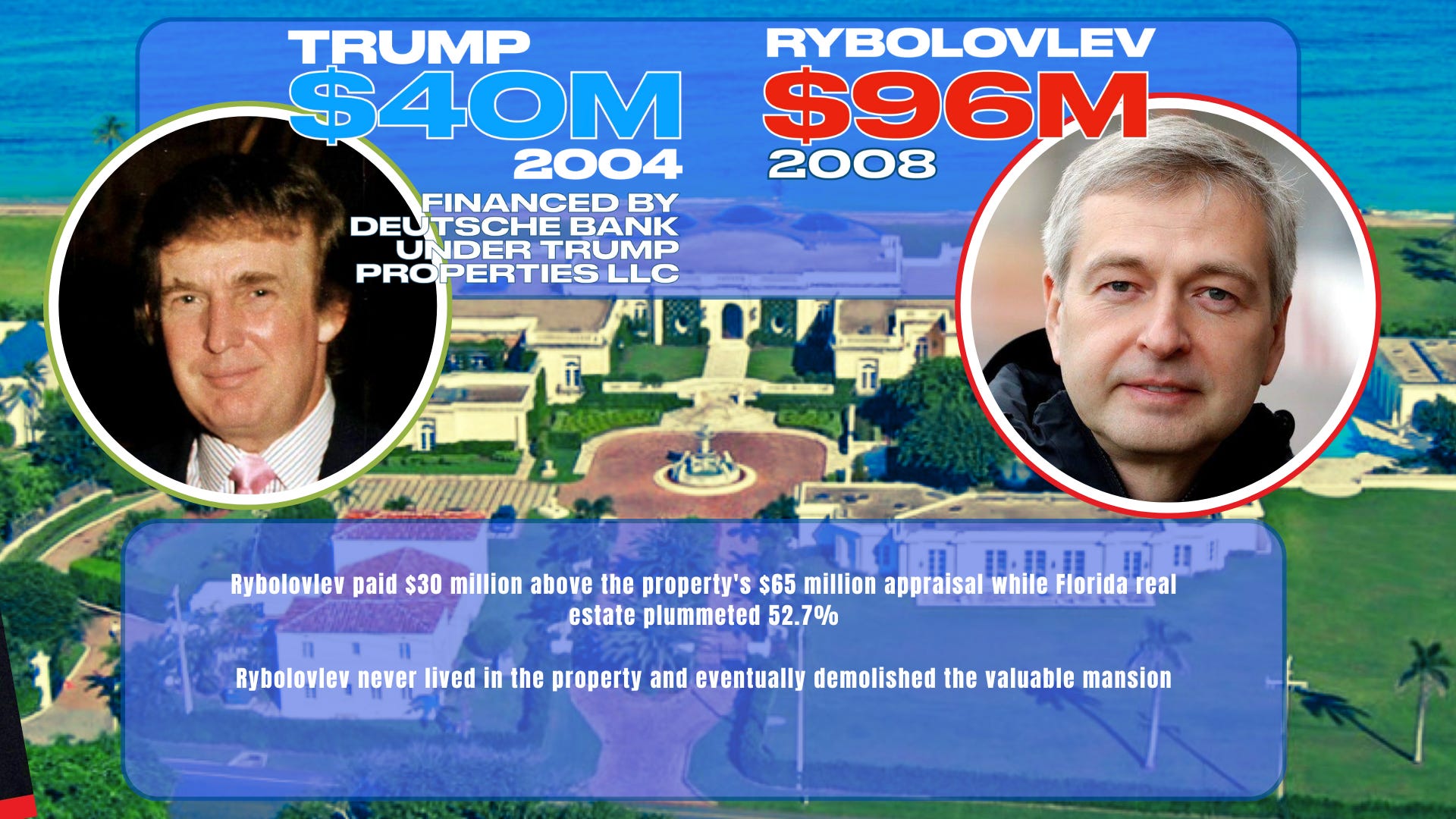
Cohen also defended Trump’s July 2008 sale of his Palm Beach mansion to Russian oligarch Dmitry Rybolovlev. The sale price: $95 million. Trump’s profit: $53 million. The timing: the depths of the financial crisis.
Cohen made five specific claims about the transaction:
On market timing: “The market didn’t tank until about eight, nine days later.”
Reality: The sale closed July 15-16, 2008. Bear Stearns had collapsed in March 2008—four months earlier. The Dow stood at 10,962 on the sale date, already down from highs above 14,000. Fannie Mae and Freddie Mac were bailed out July 30—fifteen days after the sale, not eight or nine.
On occupancy: “The daughter lived in it.”
Reality: Property records, news reports, and Rybolovlev’s own 2011 divorce documents state the mansion “remained empty since the purchase.” The house sat vacant until Rybolovlev demolished it in 2016. No one ever lived there.
On the timeline: Trump held the property “about two and a half years.”
Reality: Purchase date November 2004, sale date July 2008. That’s three years and eight months.
On the broker: Sale went through “a broker affiliated to Sotheby’s.”
Reality: Carol Digges of Brown Harris Stevens represented the buyer. Lawrence Moens of Lawrence A. Moens Associates represented Trump. Neither worked for Sotheby’s.
EPSTEIN’S OWN EMAIL: ‘CLEANSE THE MONEY’
On financing: Cohen claims Trump “had the money” and “did not have massive debt on the property.”
Reality: Trump Hotels & Casino Resorts filed for Chapter 11 bankruptcy on November 21, 2004—carrying $1.8 billion in debt, with Trump personally guaranteeing $321 million. His ownership was forcibly diluted from 47 percent to 27 percent. It was Trump’s third bankruptcy filing. Wall Street banks had coined the term “Donald risk” to describe their refusal to lend to him. Every major U.S. financial institution had blacklisted him.
In February 2019—just months before his death—Jeffrey Epstein fact-checked journalist Michael Wolff’s draft account of the transaction. Epstein had been there. He’d bid against Trump at the bankruptcy auction and lost.
Paid Subscribers Can Access A Much Deeper Dive, Including Epstein’s Own Email About The Sale And My Response To Cohen.
From: J [jeevacation@gmail.com]
Date: Fri, Feb 1, 2019 at 10:18 AM
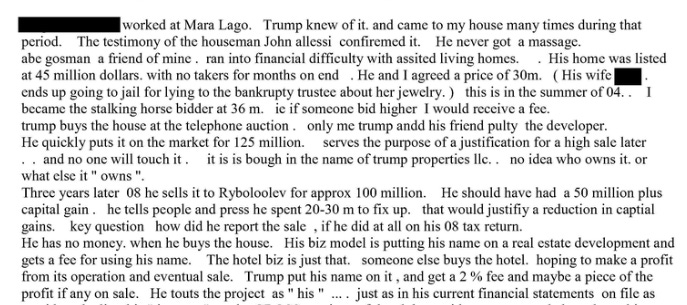
“He has no money. when he buys the house. His biz model is putting his name on a real estate development and gets a fee for using his name.”
From Wolff’s account in Epstein’s e-mail: “An incredulous Epstein saw a severely cash-constrained Trump bid $41 million for the property, buying it through an entity called Trump Properties LLC, financed by Deutsche Bank.”
Trump’s personal investment: zero dollars. Epstein knew this because he was bidding on the same property and knew Trump was bankrupt.
“Trump was willing to serve as a front man to disguise the actual ownership in a real estate transaction,” Epstein wrote. “A furious Epstein, suspecting that the real owner was a Russian oligarch, who Trump knew, Dmitry Rybolovlev—part of the close Putin circle of government-aligned industrialists in Russia—threatened to expose the deal.”
Three and a half years later, in July 2008, Rybolovlev paid Trump $95 million for the property—during the worst financial crisis in eighty years.
By November 2008, Trump had defaulted on a $640 million Deutsche Bank loan for his Chicago tower. Instead of repaying the $334 million he owed, Trump sued Deutsche Bank for $3 billion, claiming the financial crisis was an “act of God.” Lenders ultimately forgave Trump approximately $270 million in debt. Trump Entertainment Resorts filed for bankruptcy again in February 2009.
Between these two financial collapses—bankruptcy in 2004, default and debt forgiveness in 2008—Trump realized a $53 million profit on a property purchased with zero invested capital.
Epstein’s 2019 assessment of the transaction: “Trump had either miraculously earned $55 million, without putting up a dime, or Rybolovlev... paid Trump Properties, LLC—actual owner unknown—$96 million, thereby providing a clean payment of $55 million to someone. Rybolovlev might have, in effect, paid himself for the house, thereby cleansing the money.”
This wasn’t speculation from a book. This was Epstein—who witnessed it firsthand—describing it as money laundering in his final months before death in August 2019.
Cohen reviewed these sale documents as Trump’s lawyer. The financing structure—100 percent Deutsche Bank, zero equity from bankrupt Trump—would have been in those documents. Cohen would have known Trump was heading toward the Chicago default when the Maison sale closed.
Cohen’s claim that Trump “had the money” contradicts two bankruptcy filings, Epstein’s 2019 eyewitness testimony, and the archive’s financial documentation. His claim of “no massive debt” contradicts the $1.8 billion bankruptcy, the 100 percent bank financing, and the simultaneous $334 million default.
EPSTEIN FROM THE GRAVE: Details Trump's Russian Money Laundering and Tax Evasion

Five months before his death, Jeffrey Epstein documented Trump’s crimes. On February 1, 2019, he sent author Michael Wolff an email claiming that Donald Trump received $54 million through the infamous Palm Beach mansion sale.
COHEN’S OWN BOOK
According to CNN’s reporting on Michael Cohen’s 2020 book Disloyal: “Trump told Cohen he believed the real buyer was Putin.”
Cohen’s book states Trump believed Putin was the actual purchaser, with Rybolovlev serving as a front. Cohen’s Wednesday panel defense portrayed the transaction as legitimate real estate.
NO OTHER EXPLANATION
The transaction’s economics defy legitimate business logic:
A Russian oligarch pays $95 million—$30 million above the property’s $65 million appraisal—during the worst financial crisis in eighty years. The buyer never occupies the property, never furnishes it, eventually demolishes the structure, and sells the subdivided parcels at a loss after accounting for taxes and carrying costs.
The seller, who was bankrupt with zero equity in the property, realizes a $53 million profit. And the seller’s best friend reveals he was just fronting for the oligarch when he bought the property in 2004, entirely funded by a bank embroiled in a Russian money laundering scandal.
WAS THIS A CRIME?
Yes. What Epstein described—”Rybolovlev might have, in effect, paid himself for the house, thereby cleansing the money”—fits the federal statute for money laundering (18 U.S.C. § 1956): conducting a financial transaction to conceal the source or ownership of funds.
Senator Ron Wyden investigated the transaction for money laundering in 2018, requesting Suspicious Activity Reports and shell company documentation from Treasury. If the transaction was criminal money laundering, Cohen’s role reviewing the sale documents makes him either a witness or potentially complicit—which may explain why he made five false claims, refused to answer questions, and mobilized his audience to “shut down” me down.
Senator Ron Wyden investigated the transaction for money laundering. Treasury officials have characterized similar Trump transactions as “signals of money laundering.”
And readers of ‘The Greatest Heist’ are learning the depth of this crime spree as we speak.
There is no plausible explanation for this transaction pattern other than what Epstein described: money laundering with Trump serving as a front.
THE RESPONSE
Thursday night, Cohen addressed the questions on his show:
“When people start to attack Lev or Malcolm or myself, that’s when we ask you our community within which to jump in and shut them down... this guy Zev Shalev the other night started with the same shit asking me about the Jane Doe and Johnson.”
Cohen called the journalist a “schmuck” who is “full of shit and garbage.” He attacked credentials rather than addressing the documentary evidence. He instructed his paying subscribers to “shut down” the questioner rather than clarifying the contradictions in his own statements.
The pattern is familiar from Cohen’s years as Trump’s fixer: when questions become uncomfortable, attack the questioner and mobilize resources to silence them. That’s what Cohen did in shutting down Stormy Daniels for Donald, and what Trump may have done to shut down Katie Johnson.
THE LARGER QUESTION
Cohen has built his post-prison career on ‘exposing’ Trump’s crimes. He’s written books, testified before Congress, and positioned himself as a truth-teller willing to reveal what he witnessed. In reality, he’s exposed what’s politically expedient.
Yet when asked about transactions he was directly involved in—transactions that appear to constitute criminal money laundering—Cohen makes statements contradicted by court records and archive documents. When asked for clarification, he responds with personal attacks and calls for audience mobilization rather than evidence.
Either Cohen is protecting information about these transactions, or his memory of events he claims to have witnessed differs substantially from the documentary record.
WHAT’S COMING
The Epstein files are coming. Cohen’s name may not appear in those files. Or it may. Either way, the questions about what he knew, when he knew it, and why his current accounts contradict both documentary evidence and his own previous statements will remain.
Few journalists have spent as much time documenting the Trump-Epstein financial and espionage networks. Over the years I’ve been subjected to repeated attempts to harm my credibility and bury my work. Cohen’s threat to “shut me down” and hope that I “choke” over Christmas suggest he is not a reformed actor but still the same man he was when he was “fixing” for Donald Trump.
As he has associated two other people in this attempt to shut me down, both of whom have large public following, I would hope they publicly distance themselves from this call.
Either way, my work will continue. The evidence speaks for itself.
POSTSCRIPT: THE PAYOFF
Some will note that Rybolovlev recouped his investment: the subdivided parcels sold between 2016-2019 for a combined $108 million.
That doesn’t disprove money laundering. It extends it.
Mark Pulte was in the West Palm Beach bankruptcy courtroom in November 2004. He bid against Trump and Epstein for the Maison de l’Amitié. He lost. He saw the whole thing.
Thirteen years later, Pulte bought one of Rybolovlev’s subdivided parcels for $37 million—through Lawrence Moens, the same broker who handled the Trump-Rybolovlev sale. The first parcel went to an anonymous trust. The third parcel to an undisclosed buyer. All three through the same broker.
Pulte flipped his parcel in 2022 for $122.7 million—an $85 million profit on property Senator Wyden investigated for money laundering.
In January 2025, President Trump appointed Mark Pulte’s son, Bill Pulte, to run the Federal Housing Finance Agency—overseeing Fannie Mae and Freddie Mac, the agencies bailed out weeks after the 2008 sale.
The man whose father witnessed the 2004 auction and profited from the subdivided sales now controls the agencies that guaranteed the mortgage system Trump and Rybolovlev exploited. Bill Pulte has since weaponized his position to accuse Trump’s political opponents of mortgage fraud while shielding Trump allies from scrutiny.
A property purchased in a suspicious transaction, never occupied, demolished, sold through anonymous trusts using the same broker—with one buyer present at the original auction.
This isn’t just money laundering. It’s a multi-stage operation. And the witness who profited from it has his son running the system.
Narativ Has Covered Cohen For Almost A Decade. Here’s A Profile We Published In 2019.
The Spy Games

EXCLUSIVE: The Moscow Tower had everything to do with Donald Trump’s presidential run and was negotiated with Vladimir Putin’s closest advisors. Why then did Robert Mueller find no evidence of a conspiracy? The answer could lie in the spies.
This article is based on court records, property documents, archive emails, Senate investigations, and Cohen’s own published statements. Requests for clarification sent to Cohen on Thursday morning received a terse response. His Thursday night show is publicly available.


