


On the opening night of Narativ’s five-part investigation into Jeffrey Epstein, independent journalist Alisa Valdes-Rodriguez — whose document reporting at The Pugilist is the proximate cause of the 2026 New Mexico Department of Justice criminal investigation into Zorro Ranch — sat down with Zev Shalev to walk through the archive she has been building around the 7,500-acre property halfway between Los Alamos and Sandia National Laboratories where Jeffrey Epstein ran his New Mexico operation for nearly three decades.
Valdes-Rodriguez led with the microwave link. Zorro Development Corporation, the Epstein entity that held the ranch, filed five FCC microwave licenses; the estate maintained them after Epstein’s 2019 death, and when Texas millionaires Donald and Mary Catherine Huffines purchased the property in 2023 they cancelled three of the five and kept two. “It’s a bidirectional system,” Valdes-Rodriguez told Shalev. “One of them transmits from the ranch to the top of Sandia Crest.” She has pulled DOJ emails in which the general contractor who installed the system described it, in his own words, as “a military-industrial grade system, and very expensive.” The ranch next door, which shares more than two miles of fence line with Zorro, is owned by the estate of Henry Singleton — founder of the defense contractor Teledyne and, as Valdes-Rodriguez noted on air, a trustee of Ronald Reagan’s blind trust. Teledyne was later fined for knowingly selling non-functional components to Sandia. The two microwave licenses expire on July 12, 2026.
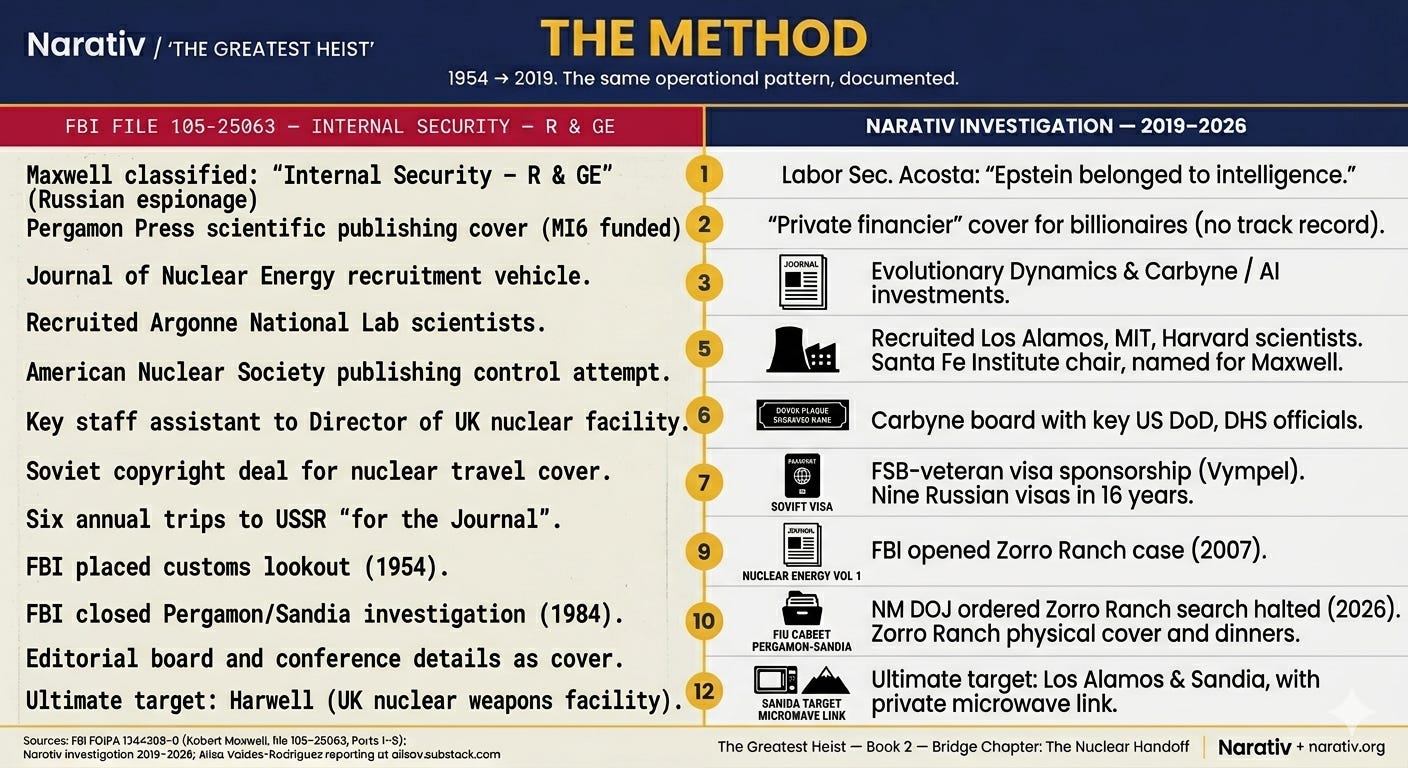
Shalev walked the audience through the Robert Maxwell FBI file — 105-25063, opened by J. Edgar Hoover on December 9, 1953 under the classification “Internal Security — R & GE” — and the parallels between Maxwell’s October 1954 attempt to recruit the directors of Oak Ridge, Brookhaven and Argonne National Laboratories through a journal he owned and Epstein’s later endowment of a chair at the Santa Fe Institute in Robert Maxwell’s name. “The simplest explanation for all of these things,” Shalev told viewers, “is these guys were spies, and they were trying to get nuclear secrets to their countries that they could sell them.” Valdes-Rodriguez reminded viewers that Ghislaine Maxwell, Robert Maxwell’s daughter, is on record saying she was the one who first brought Epstein to New Mexico.
Then came John J. Kelly. Kelly, Valdes-Rodriguez explained, was a private Albuquerque attorney and the chair of the New Mexico Democratic Party, introduced to Epstein by the sitting governor, Bruce King. Kelly signed as Epstein’s Power of Attorney on the 1993 Zorro purchase and on the state-land leases that expanded the property by thousands of acres. Eight months later, Kelly was confirmed as United States Attorney for the District of New Mexico. He served through the end of the Clinton administration. Maria and Annie Farmer began reporting Epstein to the FBI in 1996. “He never, in his entire tenure as U.S. Attorney for this district of New Mexico, ever opened any kind of investigation into Jeffrey Epstein,” Valdes-Rodriguez said. When a local TV reporter years later asked Kelly why his name appeared in Epstein’s files, Kelly replied: “You’ll have to ask Mr. Epstein.”
PAID SUBSCRIBERS CAN ACCESS A DEEPER DIVE BELOW THE PAYWALL


