


Yesterday the Supreme Court came down 6-3 in Louisiana v. Callais and gutted what was left of Section 2 of the Voting Rights Act. The ACLU is calling it Jim Crow 2.0. Barack Obama said the Court has abandoned its role in our democracy. The opinion was written by Chief Justice John Roberts. Today, on a special early edition of Narativ Live, Christopher Armitage came on to explain why he has filed a complaint with the DC Bar to have Roberts disbarred — and why anybody watching can do the same thing in ten minutes.
The Callais ruling rewrote what it takes to challenge a discriminatory map. The plaintiff now has to prove that the people who drew the lines intended to discriminate, not just that the map does. Roberts has been working to dismantle the Voting Rights Act since the Reagan administration. He wrote the 1981 memo calling the effects test a quota system. He wrote the 2013 Shelby County opinion that took the teeth out of Section 5. Yesterday he finished the job on Section 2. Forty years. Same hand. Same project.
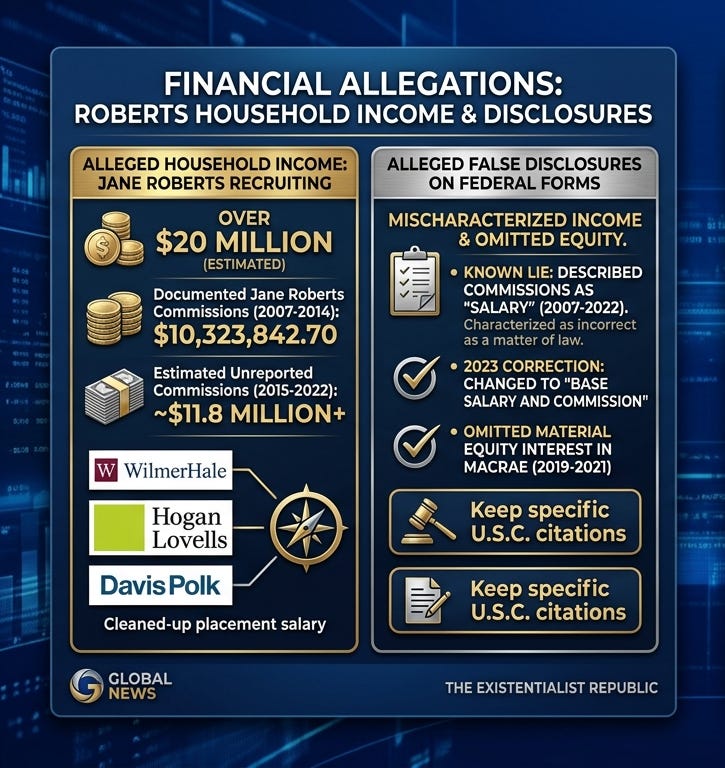
For sixteen years, Roberts has been calling something on his federal disclosure forms a salary that is not a salary. His wife, Jane Sullivan Roberts, is a legal headhunter. She places senior lawyers — the kind leaving government, the kind firms pay top dollar for — at law firms that argue cases at the Supreme Court. WilmerHale. Hogan Lovells. Davis Polk. When one of those firms hires her candidate, the firm pays her a commission. Sometimes hundreds of thousands of dollars per placement. A 2022 whistleblower complaint from inside her former firm walked the spreadsheets to Congress: more than ten million dollars in commissions over seven years. Add the years that followed at her next firm, where the public numbers go dark, and the floor estimate runs past twenty million dollars. From the firms that argue in front of her husband.

Roberts called it salary. “Commission is influenced by outcome in a way that salary isn’t as directly,” Armitage said. The Chief Justice picked the word that hides the conflict. The whistleblower was a clerk and an attorney. She knew what she was looking at. Congress held a hearing. The story quietly disappeared. About a third of the cases Roberts has weighed in on have involved firms his wife recruited for. He has not recused from a single one.
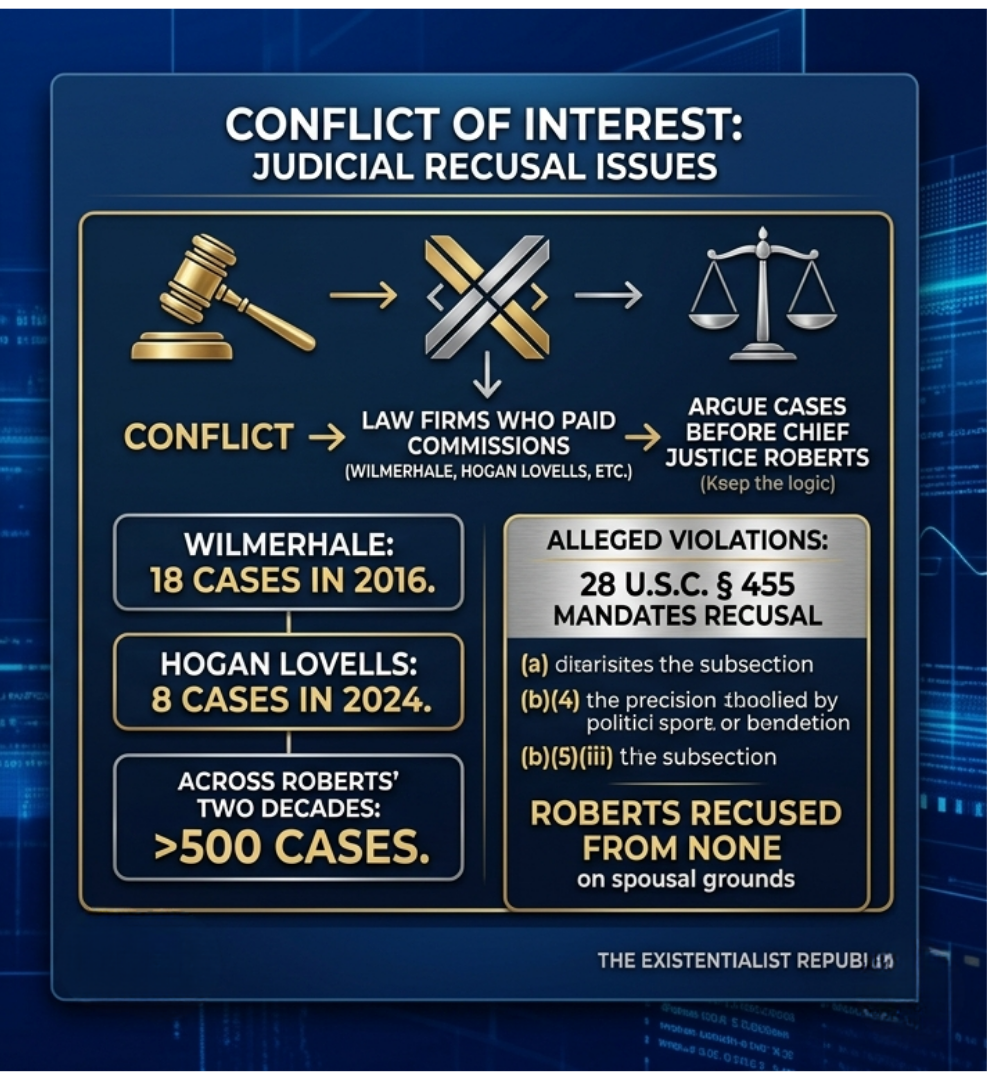
There is also an equity stake. Jane Roberts holds equity in one of the firms. A company with business in front of the Court appeared before her husband. The stake went undisclosed for three years. Bloomberg got hold of it. Roberts then filed an amended form and called the omission an error in judgment. “People have gone to jail for that with the same excuse,” Armitage said. George W. Bush’s White House ethics lawyer — when that was still a job — said Roberts fudged the paperwork in a way that is misleading. Misleading on a federal form is a crime. The Chief Justice of the United States knows that. He counted on nobody reading the forms.
The pattern holds across the conservative bloc. Ginni Thomas took money for years from conservative groups with business at the Court, then texted Mark Meadows trying to overturn the 2020 election. Clarence Thomas did not recuse from the January 6 cases. ProPublica then walked the country through more than twenty years of undisclosed gifts to Thomas from the billionaire Harlan Crow — yachts, private jets, real estate. Sam Alito took a private-jet fishing trip to Alaska with the hedge-fund billionaire Paul Singer, did not disclose it, did not recuse when Singer’s fund had a $2.4 billion case at the Court, and voted with Singer. Three of the nine. Three sets of millions. Three sets of forms with the truth missing. “The Republican Party is a criminal organization primarily,” Armitage said. “What they sell is influence.”
Disbarment will not remove Roberts from the Supreme Court. The Constitution requires only nomination and confirmation. But the DC Bar holds federal judges to the same standard as everyone else who carries its license, and Armitage’s complaint argues that on its face, sixteen years of false household-income disclosures and a hidden equity stake are a textbook violation of the recusal statutes. The DC Bar has disbarred federal judges for less. Attorneys across the country are now filing their own complaints. Retired judges are filing them. The ACLU picked up the story today. “If we get him disbarred, he will forever live in infamy as the Chief Justice whose corruption got him disbarred,” Armitage said.
History rhymes. Six years ago Narativ reported on the Federalist Society money pipeline that bought the bench Roberts sits on. Yesterday’s Callais opinion is what you get when the man at the top of that bench has spent four decades waiting to write it — and sixteen years quietly collecting on the side. The mechanism doesn’t change. The names do.
Armitage publishes The Existentialist Republic on Substack. His complaint is posted in full there at no cost. The DC Bar accepts public complaints by email and at 515 Fifth Street NW, Washington DC. Ten minutes. Your own words. Armitage was deliberate about waiting a week before posting his own filing — he wants people to write their own letter, not copy his.
Roberts has spent sixteen years counting on the certainty that nobody would read the forms.
Today, somebody read the forms.