


On November 3, 2020, Donald J. Trump lost the presidential election. Within three weeks, a group of his outside advisors — Michael Flynn, Sidney Powell, Patrick Byrne, Phil Waldron, L. Lin Wood — had gathered at Tomotley Plantation in Beaufort County, South Carolina, a private estate bought by Wood for approximately $7.9 million. They spent late November and December drafting the legal framework they believed could keep Trump in office: a draft executive order, under the authority of E.O. 13848, directing the federal seizure of electronic voting machines. They brought the plan to the Oval Office on December 18, 2020. White House Counsel Pat Cipollone declined to advance it. The plan died. Or it appeared to.
Five years later, the framework is no longer a draft in a private file. It is a published executive order signed by the President of the United States on March 31, 2026. The mechanism is different; the objective is the same. The faces have not changed. Only their proximity to power has.
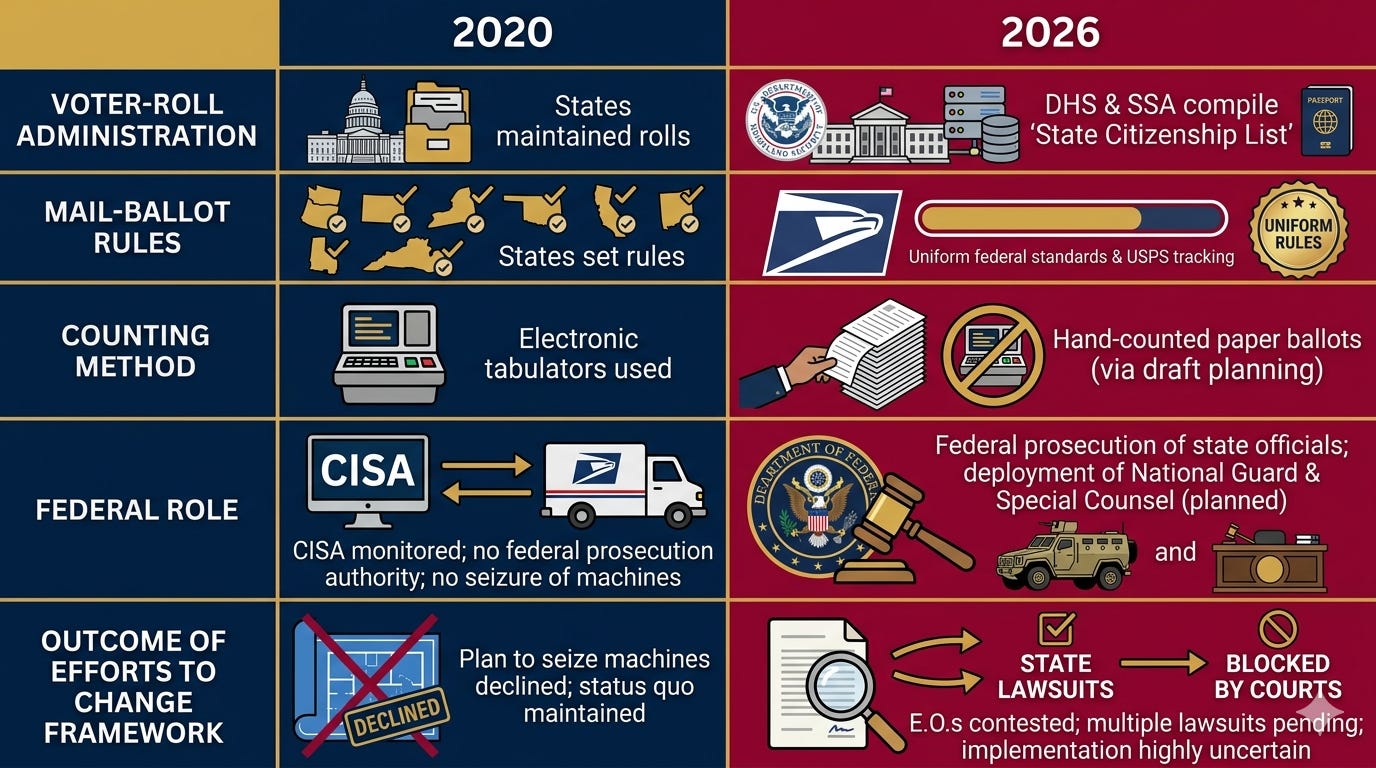
In 2020 the path runs through private litigation, fabricated technical “evidence” prepared by Phil Waldron and the outfit that became Cyber Ninjas, and a single Oval Office meeting that was blocked in the room. In 2026 the path runs through the federal register. The March 31 executive order directs the Department of Homeland Security, in coordination with the Social Security Administration, to compile a federal State Citizenship List and transmit it to every state. It directs the Postmaster General to set uniform federal standards for mail-in and absentee ballot handling, including a United States Postal Service barcode tracking system. It gives the Department of Justice criminal prosecution authority over state and local election officials who do not comply with the federal standards. A projected fourth-phase order — drafted, not yet issued — would declare a national emergency authorizing the deployment of the National Guard in federal status to support election administration, prohibit electronic vote tabulation in favor of hand-counted paper, and appoint a Special Counsel reporting directly to the president with grand jury authority. The draft’s structural flaw, per former Republican Congressman Denver Riggleman’s analysis, is that the emergency conditions lapse only upon completion of the Special Counsel’s investigations — and the president appoints the Special Counsel. Indefinite emergency, by design.

“They wanted to use 13848 as a springboard to other executive orders to nationalize the election,” Riggleman said on The Fivestack on April 17. “By generalizing or continuing to utilize conspiracy theories to throw the framework of federalization out the window, and to allow President Trump to nationalize elections based on these conspiracy theories.” Riggleman, who served as senior technical advisor to the House Select Committee on the January 6th Attack, has been walking through executive order drafts — 2020 and 2026 — for weeks. The new order, he said, “has more attack modalities” than the old one. “It isn’t just the foreign interference. Now they’re going to blame states for not complying with data-specific laws.” The states, he noted, are being asked to validate their own voter rolls against data the federal government is providing them.
“So the regime itself is going to come up with a voter’s role that they’re going to send to each state,” the host asked, “and then say — right in the EO — that’s not legal. That doesn’t make any sense.”
“Making sense is not really the goal,” Riggleman said. “Inconsistency is a feature, not a bug, of this administration.”
WHO WAS CONVICTED, AND WHO IS BEING PAID
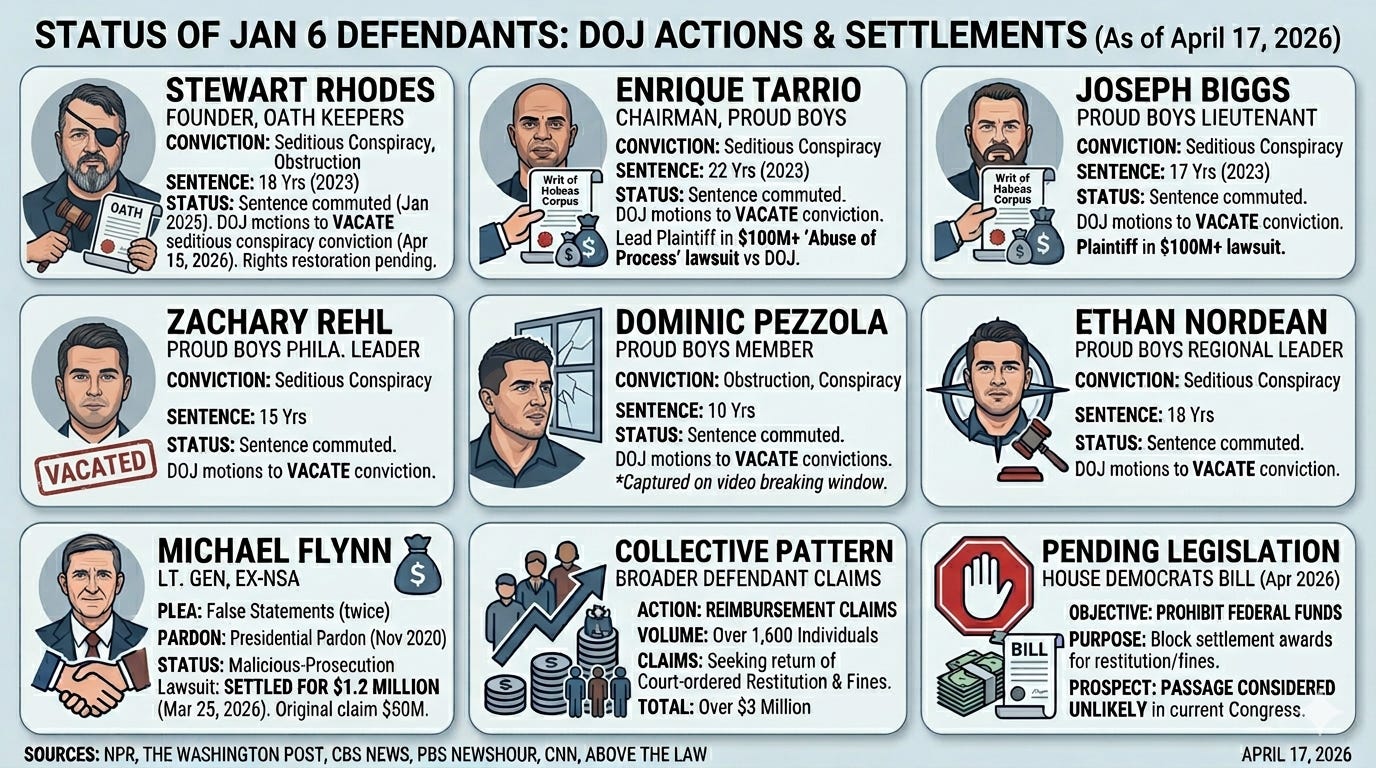
The second track of the 2026 effort is operating inside the Department of Justice itself. On April 15, 2026, Acting United States Attorney for the District of Columbia Jeanine Pirro signed a motion asking the United States Court of Appeals for the District of Columbia Circuit to vacate the seditious conspiracy convictions of twelve members of the Proud Boys and the Oath Keepers, including Oath Keepers founder Stewart Rhodes and Proud Boys chairman Enrique Tarrio. If granted — and Pirro has signaled her intent to follow the appellate vacatur with a trial-court motion to dismiss the underlying indictments with prejudice — the criminal records of every one of them are wiped clean.
Pirro’s court filing argues that continuing to prosecute these cases is “not in the interests of justice.” Representative Jamie Raskin of Maryland, ranking member of the House Judiciary Committee, responded in a statement the same day: “The Department of Justice is now acting like in-house counsel for the Oath Keepers and the Proud Boys.” It was, Raskin noted, a Trump-appointed sentencing judge who applied the federal terrorism enhancement to Rhodes and Meggs after an eight-week trial in which a unanimous jury convicted them. Rhodes was sentenced to 18 years. Tarrio received 22. Ethan Nordean, 18. Joseph Biggs, 17. Zachary Rehl, 15. Dominic Pezzola, 10. All six had their sentences commuted by Trump in January 2025 without full pardons. The April 15 motion seeks to remove the convictions themselves.
Michael Flynn, the retired Army lieutenant general and one-time National Security Advisor who participated in the Tomotley discussions and publicly called for deploying the military to swing states, received something else. On March 25, 2026, the Department of Justice settled Flynn’s malicious-prosecution lawsuit for $1.2 million. Flynn’s original demand was $50 million. The case concerned his 2017 guilty plea — twice — to lying to the FBI about his communications with the Russian ambassador, not his role on January 6th. But, as MeidasTouch Chief Washington Correspondent Scott MacFarlane noted on The Fivestack, the settlement signals an expectation. More than 1,600 January 6 defendants have filed administrative claims for reimbursement of court-ordered restitution and fines, totaling over $3 million. House Democrats have introduced legislation to block further taxpayer money to Jan 6 participants. The bill is unlikely to pass in the current Congress.
“They were convicted or pleaded guilty or were charged with seditious conspiracy,” MacFarlane said. “Seditious conspiracy means you conspire to overturn the government or democracy or an election. It’s hard to think of a more fundamentally pernicious thing to do to ensure the stability of future elections that the Department of Justice is trying to vacate those convictions. It’s a value statement.”
And at the lower end of Pirro’s docket, there are the nickels and dimes: motions asking federal courts to return several hundred dollars in restitution payments to individual Jan 6 defendants — money that had been earmarked for the victims’ fund covering the more than 140 police officers injured that day. The amount is small. The signal is not. “We are still auditioning for Trump’s approval,” MacFarlane said.
PAID SUBSCRIBERS CAN ACCESS A DEEPER DIVE BELOW THE PAYWALL


